

Quandt–Andrews परीक्षण: अज्ञात ब्रेक तिथि के लिए sup-Wald
जानें कि Quandt–Andrews sup-Wald परीक्षण एक अज्ञात regression break कैसे खोजता है, trimming क्यों मायने रखती है और शून्य-वितरण सामान्य F-वितरण क्यों नहीं होता।
इस गाइड मेंअज्ञात break date प्रश्न को बदल देती है
संक्षिप्त सारांश
Quandt–Andrews पद्धति यह जाँचती है कि अज्ञात break date होने पर regression coefficients स्थिर रहते हैं या नहीं। यह हर स्वीकार्य तिथि पर statistic निकालती है और फिर सबसे बड़ा मान लेती है। तारीख खोज के जरिए चुनी जाती है और no-break null के तहत पहचानी नहीं जाती, इसलिए यह अधिकतम किसी एक तय तारीख वाले सामान्य F-वितरण का पालन नहीं करता।
अज्ञात break date प्रश्न को बदल देती है
Chow test एक सीमित प्रश्न का उत्तर देता है: क्या परिणाम देखने से पहले तय की गई तारीख पर regression coefficients बदले? कई वित्तीय और macroeconomic उपयोगों में पहले से एक उचित तारीख तय करना कठिन होता है। कई तारीखें जाँचकर सबसे significant Chow नतीजा बताने से तारीख का चयन test का हिस्सा बन जाता है। सामान्य single-date critical values इस खोज को शामिल नहीं करतीं।
Quandt की two-regime प्रक्रिया और Andrews का बाद का asymptotic framework candidate break dates के समूह में statistic की गणना करके इस समस्या से निपटते हैं। Applied linear regression में maximum को statistic और covariance treatment के आधार पर Quandt likelihood-ratio (QLR), sup-F या sup-Wald कहा जाता है। Andrews अज्ञात change point वाले व्यापक parametric models के लिए sup-Wald, LM और LR-जैसे tests विकसित करते हैं (Quandt, 1960; Andrews, 1993)।
यहाँ दायरा जानबूझकर सीमित है: निर्दिष्ट regression संबंध में एक संभावित बदलाव को जाँचना, जबकि उसकी तारीख अज्ञात हो। यह test अज्ञात बदलावों की संख्या नहीं निकालता, कारण नहीं बताता और trading opportunity की पहचान नहीं करता। Bai–Perron मार्गदर्शिका कई अज्ञात break dates को model करने की अलग समस्या समझाती है।
एक-break regression और उसकी restrictions तय करें
मानें कि क्रमबद्ध sample में (t=1,ldots,T) observations हैं, outcome (y_t) है और regressors का vector (x_t) है। Pure one-break model है
yₜ = xₜ′β₁ + uₜ, t ≤ k yₜ = xₜ′β₂ + uₜ, t > k
यहाँ (k) पहले regime का आखिरी observation है। No-break null में जाँचे गए coefficient vectors बराबर होते हैं, यानी संयुक्त restriction (H₀: β₁ = β₂)। One-break alternative कहती है कि कम से कम एक स्वीकार्य तारीख पर वे अलग हैं। Partial-change model में केवल पहले से तय कुछ coefficients बदलने दिए जा सकते हैं; इससे restrictions की संख्या और reference distribution बदलते हैं। स्पष्ट करें कि किन coefficients को बदलने की अनुमति है।
Observations का क्रम break date को अर्थपूर्ण बनाए। Daily returns में (k) सामान्यतः trading-session index है, अपने आप calendar date नहीं। Missing observations, छुट्टियाँ, अलग-अलग समय पर खुले बाजार, contract rolls और target की परिभाषा बदलना “पहले” और “बाद” का अर्थ बदल सकते हैं। चुने split को किसी event से जोड़ने से पहले sample और date convention परिभाषित करें।
Rejection इस निर्दिष्ट constant-coefficient model के विरुद्ध और खोजे गए दायरे में किसी one-break alternative के पक्ष में साक्ष्य है। इससे यह सिद्ध नहीं होता कि किसी खास announcement ने बदलाव किया, regressors exogenous हैं या बाद के coefficients बने रहेंगे। Conditional mean, error dynamics या measurement process गलत निर्दिष्ट हो तो test साफ parameter shift के बजाय उस misspecification पर प्रतिक्रिया कर सकता है।
Candidate dates को trim करें और हर split के दोनों हिस्से fit करें
Sample के छोर के पास की candidate date से एक तरफ अनुमान के लिए बहुत कम observations बचते हैं। Trimming fraction (ε) छोरों को हटाकर खोज को पहले से तय interval, जैसे ([ε,1-ε]), में break fractions (lambda=k/T) तक सीमित करती है। Discrete sample में interval को integer dates में बदलना और दोनों segments में पर्याप्त observations तथा full-rank regressors सुनिश्चित करना पड़ता है। ठीक convention बताएं, जिसमें यह भी हो कि (k) break से पहले का अंतिम observation है या बाद का पहला।
हर admissible (k) पर pooled null model और संबंधित two-regime model fit करें, फिर coefficient-change restrictions के लिए statistic निकालें। Independent, homoskedastic errors और समान regressor set वाले classical OLS में इसे residual sum of squares की कमी से लिखा जा सकता है। Normal errors के तहत पहले से तय एक तारीख के statistic का exact finite-sample F reference distribution होता है; normality के बिना यह exact दावा नहीं निकलता। Wald रूप estimated coefficient difference को उसकी estimated covariance से मापता है। Heteroskedasticity या serial dependence में उपयुक्त robust covariance और उससे मेल खाने वाली reference विधि चाहिए। सिर्फ standard error बदलने से date-search के बाद ordinary F cutoff valid नहीं हो जाता।
Trimming test design का हिस्सा है, सजावटी विकल्प नहीं। ज्यादा trimming खोज को छोटा रखती है और बहुत छोटे regimes से बचाती है, लेकिन sample edge के पास के बड़े breaks को बाहर करती है। कम trimming ऐसे candidates जोड़ती है, पर asymptotic approximation और finite-sample estimates को अधिक कमजोर बनाती है। Statistic का peak देखने से पहले sample size, model dimension और सवाल के अनुसार range चुनें।
<!-- learn:illustration -->
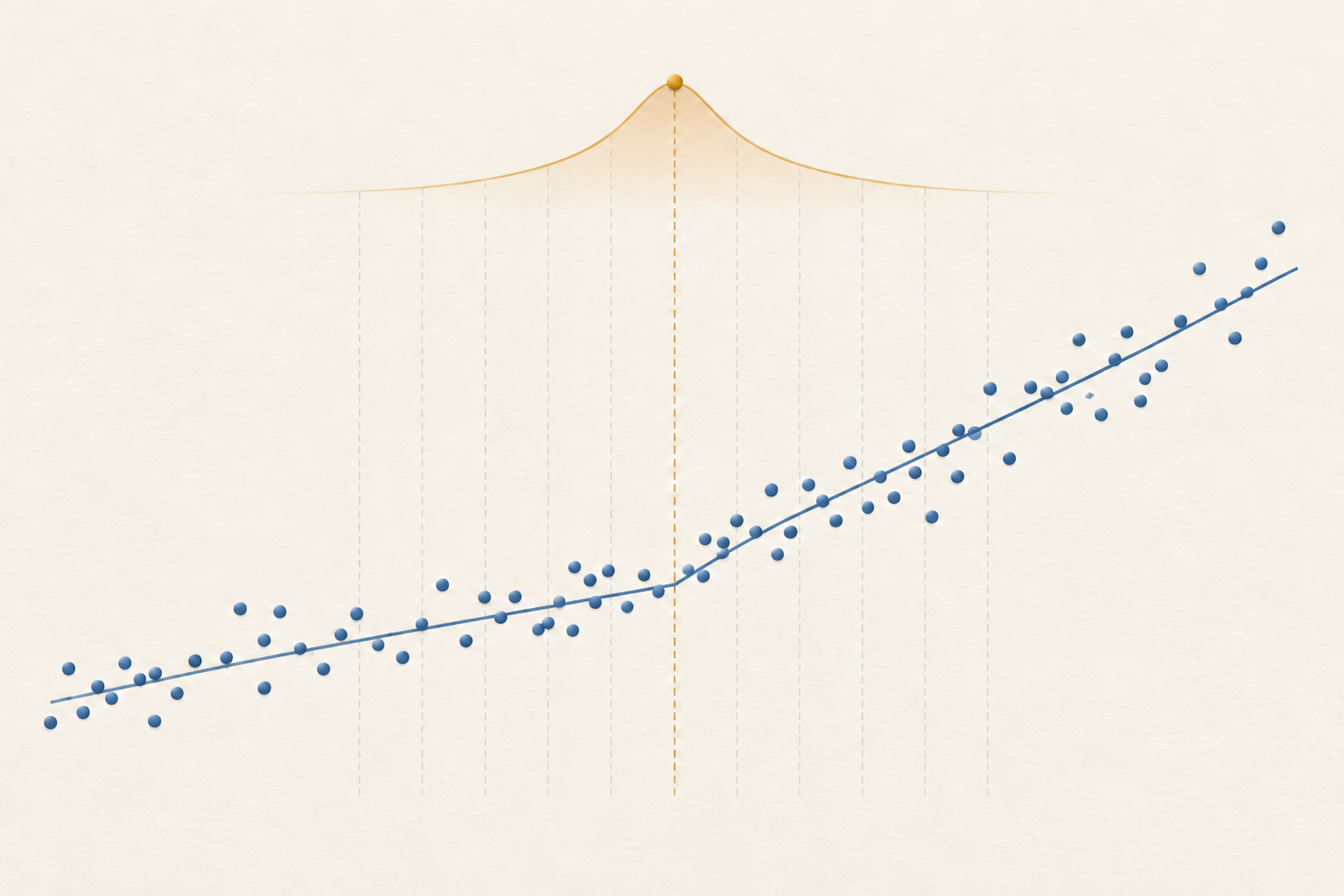
Sup-Wald statistic candidate-date statistics का सबसे बड़ा मान है
हर candidate date (k) पर specified coefficient restrictions के Wald statistic को (W(k)) कहें। One-break sup-Wald statistic है
supW = max{k ∈ K} W(k)
जहाँ (K) trimmed admissible dates का set है। Classical linear-regression implementation में candidate-date Chow F statistics का maximum लेकर उसे sup-F या QLR कहा जाता है। Maximizer (hat{k}=argmax_{kin K} W(k)) इस search में सबसे बड़ा statistic देने वाली तारीख है। यह चुना हुआ estimate है, confidence interval या आर्थिक बदलाव का सटीक समय नहीं।
ये नाम संबंधित हैं, लेकिन हर स्थिति में एक-दूसरे की जगह नहीं लेते। Assumptions के तहत fixed-date homoskedastic Chow F का exact finite-sample F reference हो सकता है। Dates पर maximum, robust covariance वाला asymptotic sup-Wald और likelihood-ratio statistic समान finite-sample values या critical values की गारंटी नहीं देते। केवल “QLR” लिखने के बजाय वास्तविक statistic, covariance estimator, trimming rule और critical-value source बताएं।
Candidate statistics बहुत dependent हैं, क्योंकि पास-पास के splits लगभग सभी observations साझा करते हैं। यह test सबसे छोटा fixed-date p-value चुनने, उसे dates की संख्या से गुणा करने या हर तारीख को independent test मानने के बराबर नहीं है। Null distribution maximum की खोज को ध्यान में रखती है।
खोजा गया maximum nonstandard null distribution रखता है
No-break null के तहत कोई वास्तविक break date नहीं होती जिसे estimate किया जाए। Date parameter alternative में है, पर null में गायब हो जाता है; इसलिए एक तय Wald या F test के सामान्य regularity arguments लागू नहीं होते। Candidate dates पर maximum लेने से nonstandard asymptotic distribution मिलती है। इसे standard F cutoff से तुलना करने पर stability के विरुद्ध साक्ष्य सामान्यतः बढ़ा-चढ़ाकर दिखता है।
Andrews sup-Wald, LM और LR-जैसे tests के asymptotic distributions तथा critical values निकालते हैं; search interval की trimming boundaries और restrictions की संख्या महत्वपूर्ण हैं (1993)। लागू values model और covariance assumptions पर भी निर्भर करती हैं। उसी test से मेल खाने वाली table, implementation या approximation लें; अलग trimming fraction या restrictions count की critical value न लें। Andrews ने बाद में corrigendum प्रकाशित किया क्योंकि आठ restrictions के लिए कुछ बताए sup-test critical values बहुत कम थे; वहाँ corrected table चाहिए (2003 corrigendum)। Hansen structural-change tests के asymptotic p-values के numerical approximations देते हैं (1997)।
Andrews और Ploberger alternative में ही मौजूद nuisance parameters के लिए average और exponential tests भी निकालते हैं (1994)। ये search-aware संबंधित procedures हैं, sup-Wald के दूसरे नाम नहीं। Bootstrap या अन्य finite-sample calibration में resampling design बताएं और जाँचें कि वह null structure और वही search दोहराती है। Generic bootstrap date selection या dependence अपने आप नहीं सुलझाता।
बारह observations का उदाहरण trimming और maximum जाँचने देता है
एक जानबूझकर छोटा hypothetical intercept-only regression लें:
y = [0, 1, 1, 1, 1, 1, 3, 3, 3, 3, 3, 3]
कुल (T=12) observations हैं। उदाहरण के लिए (ε=0.25) रखें, ताकि हर segment में कम से कम तीन observations हों और पहले segment के अंतिम candidate dates (k=3,ldots,9) बनें। यह केवल खोज का arithmetic दिखाता है; यह सुझाया trimming rule या inference sample नहीं है।
Pooled mean (23/12) है और pooled model का residual sum of squares है
RSS₀ = Σ yₜ² − (Σ yₜ)²/12 = 59 − 529/12 = 179/12
Candidate (k=6) पर पहले segment का sum और sum of squares दोनों 5 हैं, इसलिए उसका residual sum of squares (5−5²/6=5/6) है। दूसरे segment में 3 के छह मान हैं, इसलिए उसका residual sum of squares शून्य है; अतः (RSS₁(6)=5/6)। एक restriction और दो estimated segment intercepts के साथ fixed-date statistic है
F(6) = [(RSS₀ − RSS₁(6))/1] / [RSS₁(6)/(12−2)] = 169
सभी सात candidates पर यही गणना करने से (k=3,ldots,9) के लिए क्रमशः लगभग F values (7.21, 12.10, 25.28, 169.00, 20.71, 8.94, 4.59) मिलती हैं। Sup-F maximum 169 है, (k=6) पर। इससे केवल पता चलता है कि बनाई गई sequence में कौन-सा candidate सबसे बड़ा है; p-value नहीं मिलता। तारीख खोजी गई थी, इसलिए 169 को matching design के search-aware nonstandard critical value से तुलना करनी चाहिए, ordinary fixed-date F distribution से नहीं।
Rejection और non-rejection को design की सीमा में समझें
Rejection का अर्थ है कि चुने significance level और test assumptions तथा critical values के तहत admissible range का सबसे बड़ा statistic constant-coefficient null के अनुरूप नहीं है। इससे एक अनोखी, सटीक तारीख वाली break स्थापित नहीं होती। पास की candidates के statistics समान हो सकते हैं, और sample endpoint, trimming, regressors या covariance method बदलने पर peak भी बदल सकता है। (hat{k}) को सटीक मानने के बजाय candidate-statistic profile या उपयुक्त date-uncertainty analysis दें।
Non-rejection coefficient stability सिद्ध नहीं करता। छोटे बदलाव, trimmed endpoint के पास बदलाव, या test restrictions में शामिल न coefficient का बदलाव होने पर power कम हो सकती है। One-break test कुछ परस्पर offset होने वाले कई changes को भी छोड़ सकता है। इसके विपरीत, outlier, variance change, omitted dynamics, data-definition change या बार-बार specification search instability का संकेत दे सकते हैं। Test सीमित statistical प्रश्न का उत्तर है, discrepancy के कारण का नहीं।
Date उसी data से चुनी जाती है जिससे test किया गया। इसे pre-specified event date मानकर बिना adjustment दूसरा significance test करना independent confirmation नहीं है। यदि तारीख forecast update या trading rule बदलती है, तो rule स्पष्ट करके बाद के data पर evaluate करें। In-sample sup statistic post-break persistence या आर्थिक लाभ सिद्ध नहीं करता।
Chow, CUSUM और Bai–Perron के प्रश्न अलग रखें
| विधि | मुख्य प्रश्न | यह क्या नहीं करती |
|---|---|---|
| Chow test | पहले से तय तारीख पर coefficients अलग हैं? | Single-date reference distribution रखते हुए अज्ञात तारीखें खोजना |
| Quandt–Andrews sup test | Trimmed range में किसी तारीख पर एक break का साक्ष्य है? | अज्ञात break count चुनना या कारण बताना |
| Regression CUSUM | क्या ordered recursive-residual path coefficient stability से टकराता है? | अकेले एक selected break date देना |
| Bai–Perron | Multiple-break model में कितने breaks और कौन-सी dates समर्थित हैं? | One-break test के specification और selection choices को बदलना |
Hidden Markov या regime-switching model अलग सवाल पूछता है: क्या observations latent states से model हो सकते हैं जो transition probabilities के अनुसार कई बार बदलें। एक unknown-break test search range में एक persistent before/after split देखता है। ये तरीके पूरक हो सकते हैं, पर assumptions और outputs interchangeable नहीं हैं; regime-switching मार्गदर्शिका देखें।
Search को इस तरह report करें कि विश्लेषक उसे दोहरा सके
Outcome और regressors, pure या partial change, tested coefficient restrictions, sample dates और order, तथा break-date convention बताएं। (T), restrictions की संख्या, trimming fraction या exact candidate set, minimum segment size और statistic—sup-Wald, sup-F/QLR, sup-LM या अन्य—report करें। Covariance estimator, critical value या p-value method और finite-sample correction भी शामिल करें।
Candidate dates के अनुसार statistic दिखाएँ और maximizing date को selected location के रूप में बताएं; जहाँ संभव हो uncertainty या sensitivity दें। समझाएँ कि model और test design पहले से तय थे या नहीं, missing तथा real-time data कैसे संभाले, और कौन-से alternate samples या regressors देखे। Forecasting में break search को training sample तक सीमित रखें और revised model को बाद के untouched data पर evaluate करें।
एक significant unknown-break test किसी घटना का कारण नहीं बताता और profitable regime सिद्ध नहीं करता। Non-significant परिणाम stability certify नहीं करता। उचित निष्कर्ष specified one-break alternative, trimmed date range, regression, sample और search-aware inference method तक सीमित है।
आम सवाल
Q1क्या Quandt–Andrews test कई तारीखों पर Chow दोहराने जैसा ही है?
यह candidate dates पर संबंधित statistic निकालता है, पर inference में maximum को शामिल करना चाहिए। सबसे बड़ा ordinary Chow result उसके fixed-date p-value के साथ देना search को अनदेखा करता है और आम तौर पर गलत null distribution देता है।
Q2क्या maximizing date बताती है कि आर्थिक घटना ने break कब कराया?
नहीं। यह चुने sample और trimmed range में सबसे बड़ा statistic देने वाली candidate date है। यह causal timestamp या confidence interval नहीं; पास की तारीखों और design choices से समान परिणाम मिल सकते हैं।
Q3Rejection का अर्थ है कि ठीक एक break हुआ?
नहीं। यह searched range में किसी one-break alternative के विरुद्ध specified constant-coefficient null को reject करता है। कई बदलाव, outliers, variance shifts या model misspecification भी instability evidence दे सकते हैं; multiple breaks estimate करना अलग काम है।
Q4क्या sup-Wald maximum की तुलना ordinary F table से कर सकते हैं?
आमतौर पर नहीं। Sup statistic, trimming, restrictions की संख्या, model और covariance assumptions से मेल खाते critical values या p-values लें। Ordinary F distribution अपनी assumptions के तहत pre-specified date test पर लागू होती है, searched maximum पर अपने आप नहीं। मूल शोध - Quandt, “Tests of the Hypothesis That a Linear Regression System Obeys Two Separate Regimes” (1960) - Andrews, “Tests for Parameter Instability and Structural Change with Unknown Change Point” (1993) - Andrews, “Tests for Parameter Instability and Structural Change with Unknown Change Point: A Corrigendum” (2003) - Hansen, “Approximate Asymptotic P Values for Structural-Change Tests” (1997) - Andrews and Ploberger, “Optimal Tests When a Nuisance Parameter Is Present Only Under the Alternative” (1994) - Chow, “Tests of Equality Between Sets of Coefficients in Two Linear Regressions” (1960) - Bai and Perron, “Estimating and Testing Linear Models with Multiple Structural Changes” (1998) - Brown, Durbin, and Evans, “Techniques for Testing the Constancy of Regression Relationships over Time” (1975)
स्रोत और आगे पढ़ें
समस्या की रिपोर्ट करें
हम इस लेख का लिंक जोड़कर ईमेल तैयार करेंगे। भेजने के बाद ही Mark को आपकी रिपोर्ट मिलेगी
त्वरित जाँच
गाइड पढ़ने के बाद 3 सवालों से खुद को जाँचें
सवाल 01
अज्ञात break date होने पर Quandt–Andrews sup-Wald test क्या करता है?
व्याख्या देखने के लिए एक उत्तर चुनें
विकल्प शब्दावली
A model generating observations from finite discrete latent states with Markov transition probabilities and state-dependent emissions.
विस्तृत गाइड पढ़ेंएट द मनीवह स्थिति जिसमें विकल्प का स्ट्राइक मूल्य अंतर्निहित परिसंपत्ति के बाजार मूल्य के बहुत करीब हो। उसमें अभी महत्वपूर्ण आंतरिक मूल्य न हो, फिर भी बचे हुए समय और अनिश्चितता के कारण प्रीमियम हो सकता है।
विस्तृत गाइड पढ़ें