

Crypto Perpetual Futures Liquidation: Triggers, Mark Price, and Execution
Learn how maintenance margin, mark prices, cross or isolated collateral, and order-book liquidity shape crypto perpetual liquidations.
In this guideLiquidation is a risk-control action, not a planned exit order
Short summary
Liquidation is a venue's process for reducing or closing a position when the equity counted under its rules no longer satisfies the required maintenance margin. The displayed liquidation estimate is not a stop order or guaranteed fill price. The trigger reference, margin pool, order sequence, and actual execution depend on the named contract and account rules.
Liquidation is a risk-control action, not a planned exit order
A stop order is a trader-submitted instruction that may trigger when a defined price condition occurs; it can be rejected, delayed, partially filled, or filled beyond its trigger. Liquidation is a venue-initiated action under the margin agreement. It may cancel orders, submit a market order, reduce only part of a position, transfer risk to another mechanism, or follow a different product-specific process.
The account condition often compares eligible equity with a maintenance requirement. Eligible equity may include collateral and unrealized P&L, less defined liabilities or deductions. A cross-margin calculation can include multiple positions and balances, while an isolated calculation can be limited to the assigned position and collateral. Funding, fees, collateral conversion, other open orders, or a change in a maintenance tier may affect the amount available at the trigger point.
The phrase “liquidation price” compresses these moving rules into a single estimate. It can be useful as a warning field, but its display does not establish that a real position will close at that price, that the order book will have sufficient depth, or that the account has no other exposures. Futures liquidation price explains a related estimate for exchange-traded futures; crypto perpetuals add venue-specific references and collateral rules.
The trigger price may differ from the last trade
The latest matched trade is only one price field. A venue may use a mark price to value unrealized P&L and test margin, an index or oracle price as an external reference, and a last-trade price to show the latest book execution. A liquidation trigger can use one of these or a separate formula. A brief trade on a thin book may therefore differ from the value used by the risk engine, while a mark can still change as its inputs update.
Hyperliquid documents a mark price that combines external venue prices with values from its own order book and uses it for margining and liquidation. Its oracle price is a separate reference used in funding calculations. This is a concrete example of why “mark,” “oracle,” “index,” and “last” must be tied to a named venue and function; it is not a universal design. Read the current product page for the trigger field, update cadence, fallback behavior, and how a stale or unavailable input is handled.
The trigger calculation also depends on account scope. In cross mode, unrealized losses elsewhere can consume shared equity and change the position's estimated threshold. In isolated mode, the assigned margin and that position's requirements may dominate. A displayed number can move without a new order because prices, funding, other positions, collateral, or margin rules changed.
A transparent estimate needs explicit assumptions
Consider a hypothetical linear long representing 0.20 BTC, entered at $50,000 with $1,000 of allocated collateral. If the valuation price falls to $46,500, the simplified price component is 0.20 × ($46,500 − $50,000) = −$700, leaving $300 before funding, fees, collateral changes, or other account adjustments. If a hypothetical maintenance requirement were also $300, the account would be at that assumed boundary.
This arithmetic is only an illustration of a margin cushion. It is not a quoted exchange liquidation price: the actual mark could differ from $46,500; maintenance may depend on notional tiers; funding and fees can change equity; the collateral may move; cross positions may add gains or losses; and the venue may apply a buffer or another order sequence. Even the side, contract multiplier, collateral currency, and rounding method must match the instrument before a numerical estimate can be meaningful.
For a useful scenario, write down the venue and contract, position side and size, entry, valuation field and timestamp, assigned collateral, margin mode, maintenance formula and tier, funding due, fees, other positions, and execution assumptions. Recalculate the result after each material change instead of keeping a stale number as a fixed boundary.
A trigger does not determine the closing fill
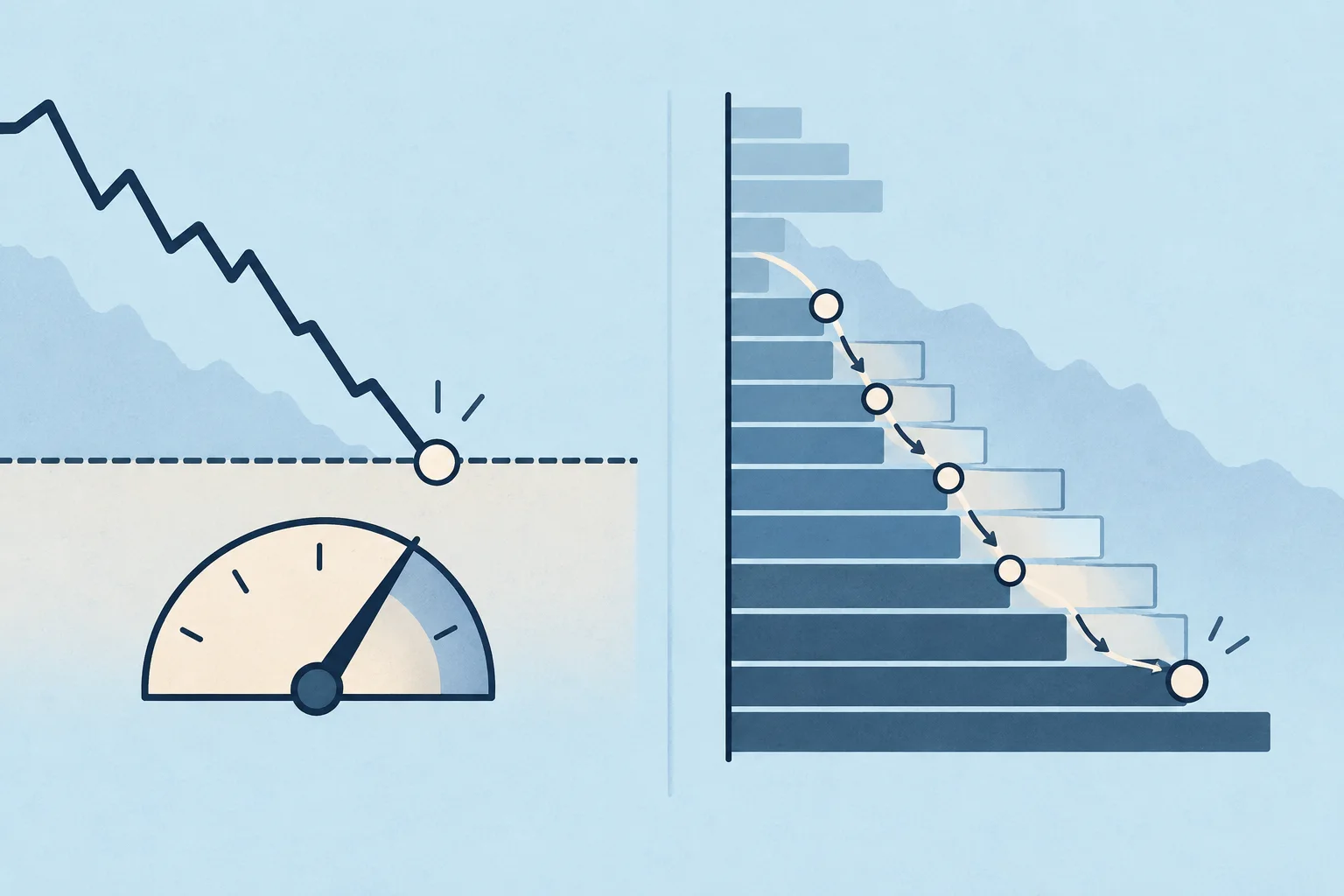
After a liquidation condition is met, the venue's process must still execute against available liquidity or use another risk mechanism. A market order can consume several price levels. If the book is thin, volatility is high, or a gap occurs, the executed average can differ from the trigger reference. A partial close may leave a smaller position that still requires margin; another venue may close the whole position or apply a backstop process.
The treatment of remaining collateral also varies. A venue can return some residual amount, retain defined fees or maintenance amounts, or transfer the position to a backstop or insurance mechanism under its terms. Do not assume that all venues use the same insurance fund, liquidation fee, socialized-loss rule, or recovery path. Read the current policy and distinguish what happened to the position from what happened to the account balance.
Cross and isolated accounts can reach the boundary differently
In cross mode, the equity pool can connect open positions. A gain in one position may support another, but multiple losses can deepen the shortfall at once. Closing one market may not make all of its displayed margin available if other positions still need it. Product-specific systems can liquidate several positions or account balances as a group.
In isolated mode, the risk pool is narrower, but the allocated collateral can still be consumed by the isolated position's losses and required margin. Isolated margin is not a guarantee against execution gaps or a promise that losses stop exactly at the displayed estimate. The venue's rules govern whether margin can be added or removed, whether the position is partially reduced, and what happens to any residual collateral.
Read the liquidation procedure before relying on the estimate
Check which price triggers liquidation; whether open orders count toward margin; how fees and funding affect equity; whether maintenance is tiered; how collateral is valued; which positions share the pool; whether the venue closes positions partially or fully; and how it treats residual balances or backstop transfers. Keep the documented product rules with a timestamp because both venue features and parameters can change.
An estimate can help explain account mechanics and compare scenarios. It cannot predict the next price, guarantee a fill, or replace a planned risk limit. This guide is educational and is not a recommendation to trade or use leverage.
Common questions
Q1Is a liquidation price a guaranteed execution price?
No. It is an estimate under stated rules. The actual trigger can use a different live input, and available liquidity can produce a different closing fill.
Q2Does a liquidation always close the full position?
No universal process applies. A venue may partially reduce, fully close, or use a backstop mechanism as its contract and account rules specify.
Q3Can a cross-margin liquidation estimate change without a trade?
Yes. Shared equity can change with other positions, price references, funding, fees, collateral values, or maintenance requirements.
Q4Does isolated margin prevent losing the allocated collateral?
No. The isolated position can consume its assigned margin, and actual execution and collateral rules remain venue-specific.
Sources and further reading
Report an issue
We’ll prepare an email with this article link. Mark receives the report only after you send it
Quick check
Read the guide? Check yourself with 3 questions
Question 01
What best describes liquidation?
Choose an answer to see the explanation
Options glossary
Clear definitions of essential option terms, from calls, puts, and option chains to IV, Greeks, open interest, and max pain
Browse the options glossary