

Linear vs. Inverse Crypto Perpetuals: P&L, Settlement, and Collateral
Compare linear and inverse crypto perpetual contracts with matched notional examples, coin-settled P&L, collateral risks, and a product-spec checklist.
In this guideWhat linear and inverse mean
Short summary
A linear perpetual typically turns a price change into profit or loss in a quote asset, while an inverse contract with fixed quote-currency face value calculates that result in the underlying coin. The label alone does not tell you the collateral, fees, price reference, or liquidation rules, so compare the instrument specification and account terms.
What linear and inverse mean
The words describe how a contract expresses exposure and calculates price P&L. In a common linear product, the position represents a quantity of the underlying coin. A change in its quoted price produces a proportional change in P&L, usually paid in the quote asset such as USDT. For a hypothetical BTCUSDT contract representing 0.2 BTC, a $1,000 BTC move changes gross P&L by $200, before fees and funding.
A common inverse product instead has a fixed quote-currency face value, such as a USD amount per contract, while its P&L is calculated and settled in the underlying coin. Its formula uses the difference between reciprocal prices. A $10,000 face-value BTCUSD position is not a promise to deliver $10,000 or 0.2 BTC; it is a contract whose coin-denominated result depends on the entry price, exit price, direction, and contract multiplier.
These are product structures, not universal names with identical specifications at every venue. “Coin-margined” is often used for inverse contracts, but a collateral label by itself does not establish the payout formula. Read the symbol, contract value, multiplier, quotation currency, P&L currency, and margin rules together.
Linear P&L follows quantity times the price change
For a simplified linear contract, let q be the signed underlying quantity, positive for a long and negative for a short. Let entry price be P₀ and exit or valuation price be P₁. Gross price P&L in the quote currency is:
P&L = q × (P₁ − P₀)
Suppose a hypothetical BTCUSDT long represents 0.20 BTC and opens at $50,000. At an assumed exit price of $55,000, the gross result is 0.20 × ($55,000 − $50,000) = $1,000 USDT. If the assumed exit price is $45,000 instead, it is 0.20 × ($45,000 − $50,000) = −$1,000 USDT. The quantity is unchanged; only the direction and size of the price move change the result.
A short can be represented by a negative q, or by reversing the price difference: quantity × (entry price − exit price). For example, a 0.20 BTC short opened at $50,000 and valued at $45,000 has a $1,000 gross gain in this simplified model. The same short valued at $55,000 has a $1,000 gross loss.
This equation is a teaching model, not a universal exchange calculator. Contract units, multipliers, average entry price, partial closes, mark-price conventions, rounding, and settlement rules can change the displayed result. Bybit’s USDT contract P&L guide presents a quantity-times-price-difference formula for its example. The contract specification still determines what one unit of quantity represents.
Inverse P&L uses reciprocal prices and pays in coin
For a simplified inverse contract, let N be the total quote-currency face value represented by the position, including the product’s contract multiplier. Let d equal +1 for a long and −1 for a short. Let P₀ and P₁ be the entry and exit prices in the quote currency per coin. The gross P&L in the underlying coin is:
P&L in coin = d × N × (1/P₀ − 1/P₁)
For a $10,000 BTCUSD face-value long opened at $50,000 and closed at $55,000, the coin result is $10,000 × (1/50,000 − 1/55,000) = about 0.0181818 BTC. The formula returns BTC, not dollars. At the assumed $55,000 exit price, that amount is worth about $1,000. The USD conversion is a valuation of the BTC result at that price; it does not change the number of BTC settled.
If the same assumed position closes at $45,000, the result is $10,000 × (1/50,000 − 1/45,000) = about −0.0222222 BTC. At $45,000, that coin amount is worth about −$1,000. The equal-and-opposite quote-currency examples do not make the coin amounts equal: a $1,000 gain is fewer BTC at the higher exit price, while a $1,000 loss is more BTC at the lower exit price.
The face amount and multiplier must come from the exact product. Binance’s P&L guide describes its BTC COIN-M example with a fixed USD amount per contract and calculates inverse P&L in BTC. Bybit’s inverse-contract P&L guide likewise shows the reciprocal-price formula and coin-denominated result. Those pages are examples of their products, not specifications for every venue.
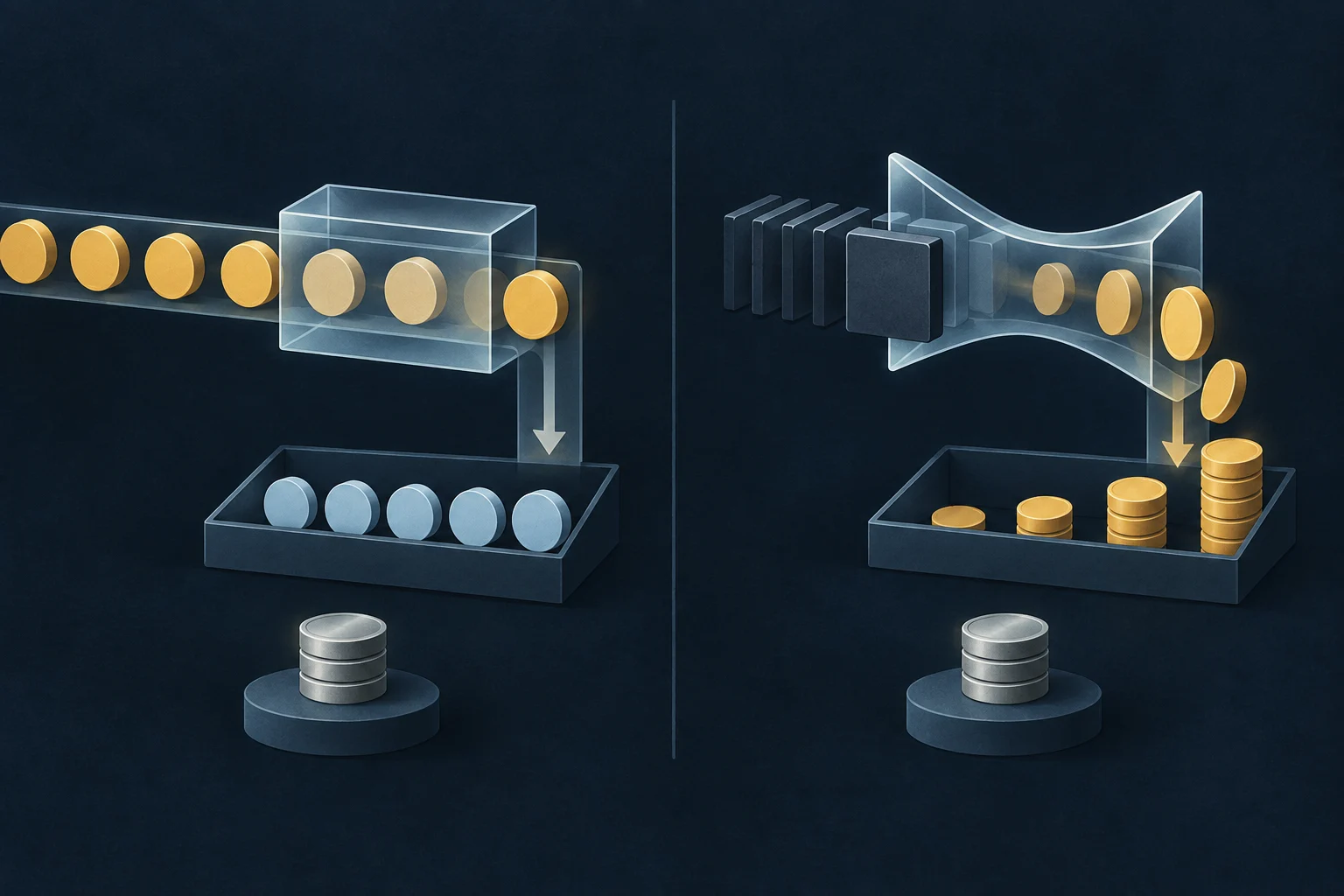
Compare the same entry notional, not just the same displayed size
The two examples above start with the same simple $10,000 exposure at a $50,000 BTC price. The linear position is 0.20 BTC × $50,000. The inverse position is $10,000 of face value. That matched starting point makes the arithmetic easier to compare, but the contract quantities are expressed in different units.
| Assumed BTC price | Linear: 0.20 BTC long | Inverse: $10,000 face long |
|---|---|---|
| Entry at $50,000 | Reference notional: $10,000 | Face value: $10,000 |
| Exit at $55,000 | +$1,000 USDT gross | +0.0181818 BTC, worth about $1,000 at $55,000 |
| Exit at $45,000 | −$1,000 USDT gross | −0.0222222 BTC, worth about −$1,000 at $45,000 |
The rows compare hypothetical gross price P&L before commissions, funding, spread, slippage, or other charges. The quote-currency values are converted at each assumed exit price. If you compare contracts at a different entry price, use the same initial notional and state the conversion price; comparing “one contract” or “one coin” across products can be meaningless when contract sizes differ.
There is also a useful algebra check. Converting the inverse result back to quote currency at P₁ gives d × N × (P₁/P₀ − 1). If the linear quantity is chosen as N/P₀ at entry, its simplified quote-currency P&L matches that conversion for the same entry and exit prices. The key practical difference is the unit in which the result is settled and retained, plus the product’s collateral and margin rules—not a claim that every matched inverse trade must have a larger or smaller dollar price result.
Coin settlement creates a second price exposure after P&L is calculated
Suppose the inverse long above realizes a gain of 0.0181818 BTC. If the account keeps that BTC and its later reference value is $50,000, the retained gain is then worth about $909.09. At $60,000, the same BTC amount is worth about $1,090.91. The original realized result remains 0.0181818 BTC; its later USD value changes because the settlement asset changes value.
This distinction matters when the account reports a profitable position in coin but the trader measures savings, expenses, or risk limits in dollars or another currency. The P&L formula answers “how many settlement coins did this position produce under the contract rule?” A later conversion answers “what is that coin balance worth at this later price?” Combining those into one number without recording the conversion price hides a separate market exposure.
The same applies to a loss. A loss of 0.0222222 BTC has a quote-currency value tied to the price used for conversion. If the loss is paid from a coin balance that is also moving in price, the account’s remaining collateral value can move at the same time. Keep position P&L, coin balance, collateral valuation, and any stablecoin conversion as separate ledger lines.
Payoff structure and collateral are separate axes
It is tempting to assume that every linear contract is funded only with a stablecoin and every inverse contract uses only the underlying coin. That shortcut can be wrong. A contract’s payoff formula, the currency in which P&L is settled, and the assets the account accepts as collateral are separate fields to verify.
For example, Bybit states that its USDT perpetual positions settle P&L in USDT. Its Unified Trading Account rules also say that cross-margin or portfolio-margin users may use other supported assets as collateral, subject to that account’s rules. In that arrangement, USDT settlement does not mean the account’s collateral value is insulated from BTC or other supported assets. The inverse product’s base-coin settlement is another matter: it determines the unit of the position P&L, while the actual margin pool, haircuts, borrowing, and liquidation process still depend on the account and contract. See Bybit’s USDT perpetual contract overview for the product-specific details.
Consider a trader who posts 0.10 BTC as collateral while holding a long inverse position. At $50,000, that collateral has a simple reference value of $5,000. If BTC falls to $45,000, the same 0.10 BTC is worth $4,500 before haircuts or other account effects. If the inverse position also loses coin under its contract formula, both the position result and collateral valuation affect account equity. This is a deliberately simplified illustration, not a liquidation calculation. A cross-margined linear position using BTC collateral can also be exposed to a falling BTC collateral value even though its P&L is settled in USDT.
The practical lesson is not that one structure is inherently safer. It is that a trader can be exposed to the underlying coin through the position, through collateral, through the settlement asset retained after closing, or through several of these at once. Isolated versus cross margin, eligible collateral, conversion haircuts, risk tiers, and close-out rules can change the result.
Leverage changes the margin denominator, not the gross payoff formula
For a fixed quantity, entry, and exit, raising the leverage setting does not multiply the gross price P&L in either formula. It changes the initial margin that the venue requires and therefore can change a displayed return-on-margin percentage. A higher percentage can come from a smaller denominator; it does not mean the same position generated more gross P&L.
Actual account results can also include opening and closing fees, funding payments, spread, slippage, settlement charges, and product-specific adjustments. Unrealized P&L may use a mark price, while realized P&L follows fills or another venue-defined settlement price. Bybit’s help pages explain these distinctions for its own products. Use the right price field for the question: a mark-based estimate is not necessarily the price at which the position can be closed.
A partial close creates another bookkeeping detail. Some venues allocate opening fees or funding to the closed part and keep a remaining position with a new average entry price. A coin-denominated inverse result can also be converted at a different price from the one used in a chart or account widget. Reconcile the trade history and product-specific P&L statement instead of treating a generic formula as the final account record.
A practical comparison before reading a venue’s headline
Before comparing or using a linear or inverse perpetual, record the exact contract and answer these questions:
- What does one unit mean? Is the order quantity measured in base coins, quote-currency face value, or contracts with a multiplier?
- What is the payoff formula? Does the price component use quantity × price change, reciprocal prices, or another product-specific calculation?
- What currency is P&L settled in? Do not infer it from the pair name or the collateral symbol.
- Which collateral assets count? Check haircuts, conversion prices, borrowing, margin mode, and whether positions share a pool.
- Which price does each screen use? Distinguish mark, index, last trade, actual fills, and the settlement price defined by the venue.
- What costs belong in the result? Add both execution fees, eligible funding events, spread or slippage, and any other stated charge without double-counting them.
- What is the comparison basis? Match entry notional, side, exit assumptions, collateral, and conversion time before comparing products.
A useful decision starts with the currency of the exposure and the account’s intended use of the settlement asset. Someone who needs to measure the result in a stablecoin may prefer to inspect a quote-currency payoff and stablecoin-settlement rules; someone already managing coin-denominated liabilities may care about receiving P&L in that coin. Neither preference removes price, venue, liquidity, collateral, or liquidation risk. This guide compares contract mechanics and does not recommend a venue, leverage level, or trade.
For the broader product picture, see the crypto perpetual contract guide. The margin guide separates exposure from required collateral, while the trading-cost guide reconciles fees and funding. The mark-price guide explains why a displayed price may differ from the price used for risk or execution.
Common questions
Q1Does higher leverage increase a linear or inverse contract’s gross P&L?
No. With the same position size and price path, the simplified gross price result is unchanged. Leverage changes the required margin and can change return-on-margin percentages and liquidation risk.
Q2Is every linear perpetual collateralized only in USDT?
No. A venue may allow supported collateral assets under cross or portfolio margin while settling a linear contract’s P&L in USDT. Check the exact account rules.
Q3Why can an inverse P&L show a different dollar value later?
The contract result may be realized in the underlying coin. If that coin remains in the account, its later dollar value changes with the coin price; the realized coin amount itself does not change.
Sources and further reading
Report an issue
We’ll prepare an email with this article link. Mark receives the report only after you send it
Quick check
Read the guide? Check yourself with 3 questions
Question 01
What is the key unit difference in a common inverse contract?
Choose an answer to see the explanation
Options glossary
Clear definitions of essential option terms, from calls, puts, and option chains to IV, Greeks, open interest, and max pain
Browse the options glossary