

Crypto Mark Price vs. Last Price: Why Liquidations Differ
Compare index, mark, and last-trade prices in crypto perpetuals, see which reference may trigger liquidation or a stop, and learn why a chart price is not always the risk price.
In this guideThree price references answer different questions
Short summary
A crypto perpetual screen can show a last trade, an index, and a mark at the same time. They are different measurements. The price used to draw a candle, estimate an open position, trigger a stop, or start liquidation depends on the product and account rules.
Three price references answer different questions
The last traded price is the most recent matched trade on that venue’s contract book. It is a historical execution, not a promise that a new order can trade there and not necessarily the latest spot price elsewhere.
An index price is a reference assembled from specified spot markets or another published input. The venue chooses eligible markets, weighting, update timing, outlier handling, and fallback behavior. An index is not itself a fillable order.
A mark price is a venue-defined reference used for risk or valuation. It may combine an index, a basis between the perpetual and its reference, funding data, and prices from the venue’s own or other derivatives books. There is no single formula shared by every exchange.
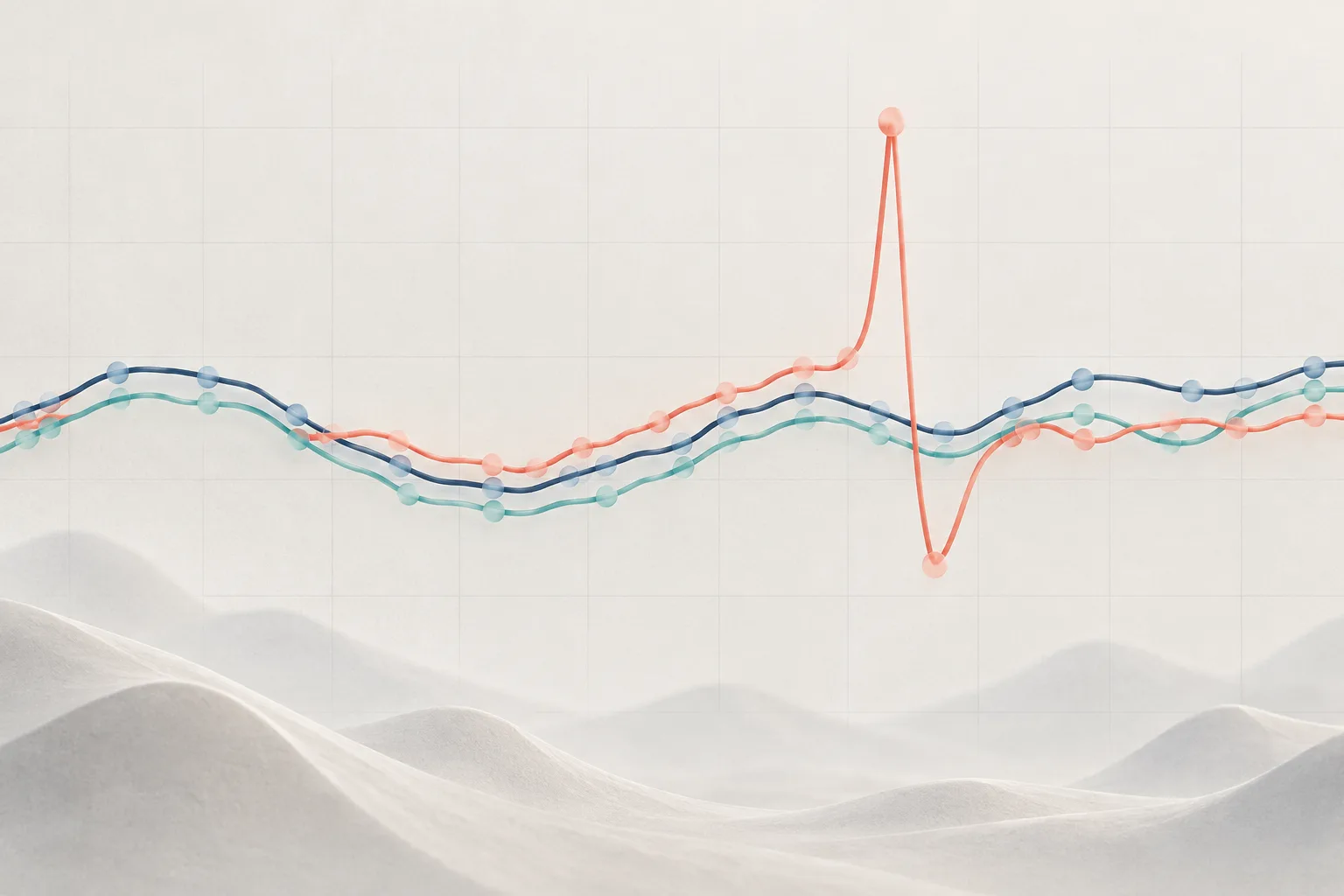
The distinction matters because a single trade in a thin book can move the last price while broader spot references remain steady. The opposite can happen too: external markets can move before a local contract’s last trade updates. A mark may smooth or combine these inputs, but it is not a guarantee that the price is fair, executable, or immune to a bad input.
Why the three numbers can separate
Perpetual contracts trade in their own order books. Their last price reflects a local match; their index can reflect several spot venues; and their mark can include a calculated premium or basis. Different update clocks, liquidity, market hours for a constituent, stale feeds, and temporary order-book imbalances can therefore produce different values.
A basis is not automatically an error. Buyers and sellers may value a perpetual differently from spot, while funding rules and arbitrage activity create incentives that can pull prices closer over time. A short-lived wick in the local book can also occur without a comparable move in the index. Conversely, an index constituent can jump or become unavailable while the local book still shows older trades.
A mark-price formula can reduce the influence of one input, but it also inherits the assumptions and failure modes of its inputs. Check the contract page for the eligible markets, calculation window, outlier rules, fallback source, and whether the formula differs for pre-launch or less-liquid products. Do not infer those details from another asset or venue.
Liquidation may follow a different line from the chart
Many perpetual products use a mark price in their liquidation or margin-risk process. Bybit’s perpetual FAQ says liquidation is triggered by mark price rather than last traded price. Binance’s futures protocol also describes mark price as the liquidation reference. Hyperliquid documents mark price as an input to margining and liquidation, while the account’s equity and maintenance-margin condition determine whether the account is liquidatable.
That last distinction matters. A displayed liquidation price can be useful for an isolated position, but cross-margin or portfolio-margin accounts may depend on other positions, collateral values, funding, and maintenance requirements. A single chart level is not a complete account-risk model. Product type and margin mode can change the rule.
A chart may plot last trades even when the risk engine uses mark. A candle can therefore appear to cross a displayed liquidation line without the mark crossing its trigger, or liquidation can occur while the last-price candle still appears on the other side. Confirm which price the chart shows before comparing it with the account’s liquidation field.
A trigger is also separate from the liquidation fill. Once a risk condition is met, the venue’s liquidation process sends or manages closing orders under its own rules. In a fast or thin market, the resulting execution price can differ from the reference that triggered the process.
A hypothetical snapshot shows why one price is not enough
Assume a linear long position has a displayed mark-based liquidation threshold of $96.00. The snapshots below are invented to illustrate the relationship; they are not a venue formula or a prediction.
| Snapshot | Last trade | Index | Mark | Mark-based result for the long |
|---|---|---|---|---|
| A | $95.70 | $96.18 | $96.08 | The mark remains above $96.00, so this price condition has not crossed |
| B | $96.22 | $96.02 | $95.94 | The mark is below $96.00, so the price condition has crossed |
In snapshot A, a last-price candle can print below the threshold while a mark-based trigger remains uncrossed. In snapshot B, the last trade is above the threshold while the mark has crossed it. The table does not say what the final account outcome must be: margin mode, account equity, maintenance requirements, and the venue’s liquidation process still matter.
Use the example to ask a precise question: which reference and which account condition does this contract use? Do not “correct” one field by substituting the other.
Unrealized P&L, realized P&L, and fills are not interchangeable
An interface may calculate or display unrealized P&L from last price, mark price, or a user-selected view. Bybit’s P&L FAQ, for example, describes last price as the default display basis in some views and says users can switch to mark price. Hyperliquid’s documentation describes mark price as its unrealized-P&L reference. Those examples show why a P&L label must be read with the product and interface settings.
Realized P&L is based on the position’s actual opening and closing fills under the contract’s payoff rule. The last trade is only the latest match on the venue; it may not be your fill. Fees and funding are separate ledger entries even when a screen groups them into a displayed total.
For a hypothetical one-unit linear long opened at $100,000, suppose the last trade is $99,500 and the mark is $99,800. A last-price estimate shows a $500 unrealized loss; a mark-based estimate shows $200. If the position is actually closed at $99,460, the price result from the fills is a $540 loss before fees and funding. None of the three numbers can replace the account statement.
A stop trigger is not the price you are guaranteed to receive
Conditional orders can let a user choose a trigger reference such as last, mark, or index, but the available choices vary. Hyperliquid’s TP/SL documentation says its orders trigger from mark price. A triggered market order then interacts with available bids or asks; a triggered limit order may remain unfilled. A trigger price is a condition, not an execution promise.
A last-price stop can react to a brief local wick that does not move the mark as much. A mark-price stop can activate when the mark reaches its level even if the last trade has not printed there. After either trigger, the order still faces liquidity, gaps, latency, and the venue’s price-protection rules. A stop is not a guarantee against liquidation or a guaranteed exit price.
When checking a stop, record both its trigger type and its order type. Then compare the trigger time, order submission, partial fills, remaining quantity, and any cancellation or protection rule. Looking only at the line drawn on a chart can hide which step did not occur.
The formula is venue-specific
Bybit’s published perpetual mark-price page gives one example: a median of two calculated prices and the last traded price. Its inputs include an index, a funding-based adjustment, and a moving basis measure. This is Bybit’s described method for the product covered by that page, not a universal definition of mark price.
Hyperliquid documents a different robust mark construction using several components: an oracle price adjusted by a moving average of its book basis, a value derived from its own best bid, best ask, and last trade, and a median of selected external perpetual mid-prices. Its docs say mark is used for margin, liquidation, TP/SL triggers, and unrealized P&L. The composition makes the point: two venues can use the same label while measuring different things.
For both venues, the cited documents can change. Before relying on a number, open the current specification for the exact asset and contract. Confirm whether the page is for a spot market, standard perpetual, pre-launch contract, or a different account product.
A short review checklist for any platform
Before interpreting a price or comparing exchanges, write down:
- The exact contract, collateral, and margin mode
- Whether each chart and P&L field shows last, mark, or index price
- The index constituents, mark formula, update interval, and fallback rules
- The condition that triggers liquidation for this account mode
- The stop’s trigger reference and whether it submits a market or limit order
- The actual fills, fees, funding, and timestamps shown in the account record
Then compare the contract’s primary documentation with the live account fields. Related guides on perpetual funding rates, perpetual liquidation mechanics, and crypto perpetual trading costs cover the neighboring ledger and risk questions. A price reference can clarify how a venue operates; it does not tell you whether a position is suitable or predict where the market will go.
Common questions
Q1Can a last-price wick cross my liquidation level without liquidating me?
It can happen when the venue uses a different reference, such as mark price, and the account’s liquidation condition has not been met. Check the exact contract and margin mode.
Q2Does mark price always mean the same thing on every exchange?
No. Each venue defines its inputs, calculation, timing, and use. Read the specification for the exact product.
Q3Will a stop order fill at its trigger price?
Not necessarily. A trigger submits or activates an order; the fill depends on order type, available liquidity, price gaps, and venue rules.
Sources and further reading
Report an issue
We’ll prepare an email with this article link. Mark receives the report only after you send it
Quick check
Read the guide? Check yourself with 3 questions
Question 01
What does the last traded price represent?
Choose an answer to see the explanation
Options glossary
Clear definitions of essential option terms, from calls, puts, and option chains to IV, Greeks, open interest, and max pain
Browse the options glossary