

How to Read Forex Quotes: Base, Quote, Bid, and Ask
Learn what EUR/USD 1.08425 means, which currency a buy or sell applies to, and how bid and ask affect the price you receive.
In this guideRead the pair as a price ratio
Short summary
A currency-pair quote gives the price of one unit of the first currency in the second currency. EUR/USD 1.08425 means one euro is priced at 1.08425 U.S. dollars. On a typical two-way dealer quote, a trader buys the base currency at the ask and sells it at the bid. The instrument and provider determine the exact contract and execution rules.
Read the pair as a price ratio
In EUR/USD, EUR is the base currency and USD is the quote currency. The number after the pair tells you how many units of the quote currency are priced for one unit of the base currency. A quote of 1.08425 therefore expresses 1.08425 USD per EUR 1.
That number is a relative price, not a dollar balance, a forecast, or a promise that a retail customer can exchange at that exact rate. A quote can be a midpoint, a reference rate, a dealer's bid or ask, or a price for a different instrument. Check the field and product before interpreting it.
The trade direction applies to the first currency
Buying EUR/USD means buying euros and selling U.S. dollars at the quoted relationship. Selling EUR/USD means selling euros and buying dollars. This is why a long EUR/USD position is not simply a bet that the dollar rises: it has long-euro and short-dollar exposure.
If EUR/USD rises, one euro is priced in more dollars, so the euro has strengthened relative to the dollar over that interval. If the quote falls, one euro is priced in fewer dollars. The pair's direction describes that ratio; it does not by itself state the return in a different account currency.
Bid and ask are the two sides of a quote
A two-way quote commonly shows a bid followed by an ask. The bid is the price at which the dealer is willing to buy the base currency; the ask is the price at which the dealer is willing to sell it. From the customer's side, selling the pair generally uses the bid and buying the pair generally uses the ask. OANDA's U.S. help page is one provider-specific explanation of these labels, not a universal contract specification.
The ask is normally above the bid. Their difference is the quoted spread: ask minus bid. A spread is expressed in the pair's price units first; converting it into pips or money also requires the pair's pip convention and position size. Commission, conversion charges, and execution slippage are separate items.
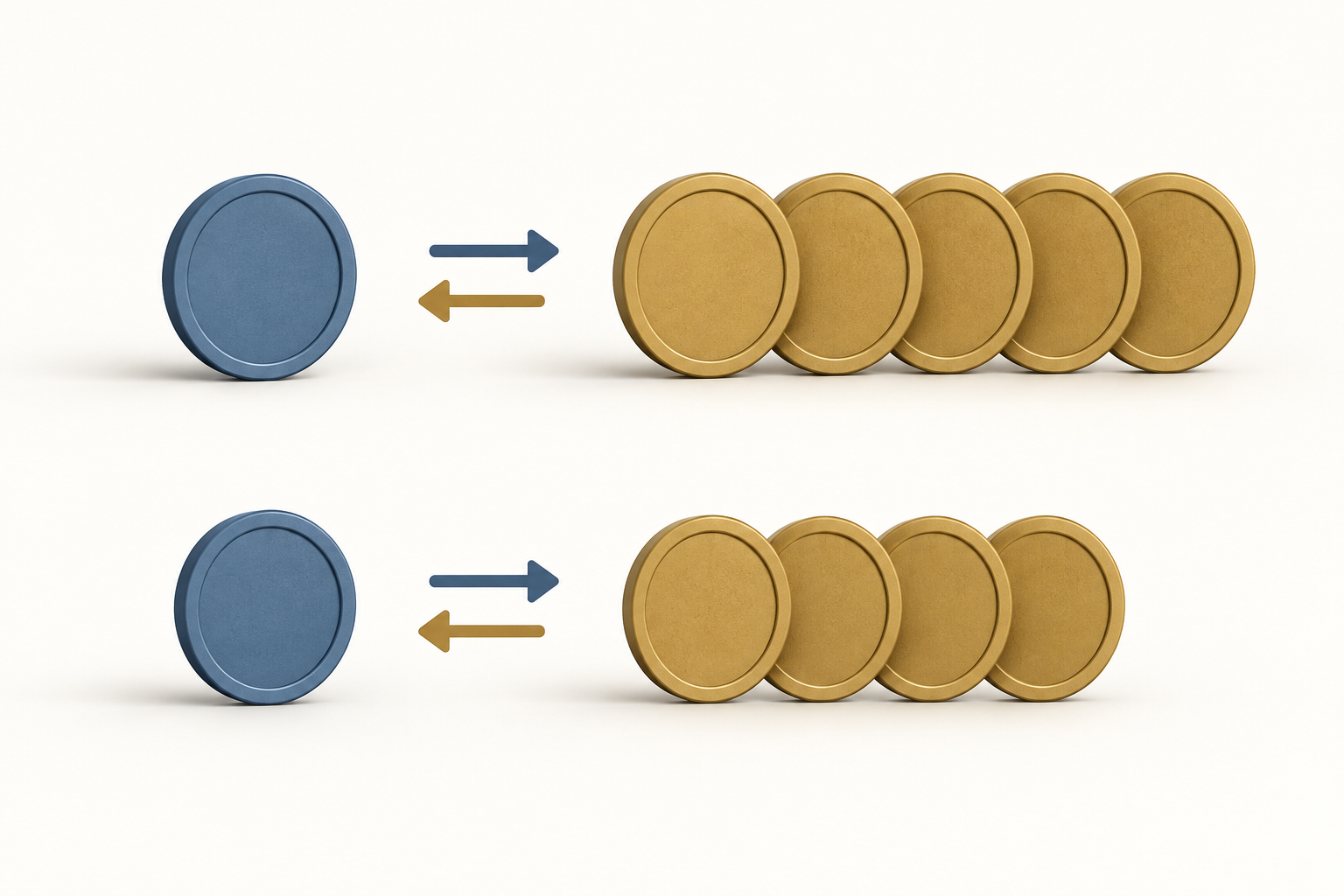
Calculate a round trip from the prices you could trade
Suppose a hypothetical EUR/USD quote is 1.08425 bid and 1.08440 ask. The spread is 0.00015. If the pair uses a 0.0001 pip convention, that is 1.5 pips. A customer buying 10,000 EUR enters at the ask, so the quote-currency amount exchanged is about 10,844 USD before any product-specific treatment.
Later, suppose the quote is 1.08525 bid and 1.08540 ask. Closing the long position means selling EUR at the new bid. The simplified gross price result is 10,000 × (1.08525 − 1.08440) = 8.50 USD. The mid-price rose 10 pips between the two snapshots, while this entry-to-exit calculation captures 8.5 pips before commission, financing, conversion, and slippage.
These numbers are invented to show the arithmetic. They do not represent a live market, a typical spread, or a result a trader could obtain. A provider may change its quote, apply a different pip or quantity convention, or fill an order away from the displayed price.
Reversing the pair also reverses the two quote sides
The reciprocal of EUR/USD is USD/EUR, but you cannot reverse the label and leave the same number. If EUR/USD is quoted 1.08425 bid / 1.08440 ask, the corresponding USD/EUR bid is approximately 1 ÷ 1.08440 = 0.92217, and its ask is approximately 1 ÷ 1.08425 = 0.92230, after rounding.
The bid and ask reciprocals switch order because buying one unit of USD in the inverse pair corresponds to selling USD for EUR in the original pair, and the opposite transaction uses the other side. In practice, two independently quoted markets may not match these exact reciprocals after spreads, timing, and rounding. Treat the calculation as a convention check, not an executable arbitrage.
A pip, a displayed digit, and a trade size measure different things
Many EUR/USD products use 0.0001 as one pip; a display may add another decimal place for a smaller pipette or point. Many yen-quoted pairs use 0.01 as a common pip size. These are conventions, and a futures contract, CFD, or broker platform may define its minimum tick differently. Read the instrument specification rather than inferring the unit from screen precision alone.
The price increment is also different from the position quantity. A lot may represent a provider-defined number of base-currency units, while a contract can have its own multiplier. The forex lot-size and pip-value guide explains how quantity and pip value turn a price move into a monetary result.
The quote currency may differ from your account currency
Price profit and loss is first calculated in the product's settlement or quote currency under its contract rules. For example, a simplified 10,000 EUR long in EUR/GBP that gains 0.001 GBP per EUR has about 10 GBP of gross price P&L, not 10 USD. A USD-denominated account still needs a separate GBP-to-USD conversion.
The provider's conversion rate, conversion time, fees, and account terms affect the final booked amount. Keep the pair price, position quantity, quote-currency result, and account-currency conversion in separate lines. For larger positions, changing notional and margin rules can also make a simple price-difference calculation incomplete.
Reference rates, dealer quotes, and futures quotes are not interchangeable
The ECB says its euro reference rates are published for information and are not necessarily the rates at which transactions take place. A reference midpoint can help describe currency values, but it is not the same as a dealer's executable bid or ask. The ECB's example also makes clear that the number of foreign-currency units per euro depends on the stated quote direction.
In U.S. retail OTC forex, the CFTC describes the dealer as the customer's counterparty and explains that the dealer controls the platform information and conditions it offers. That is a U.S.-scope example, not a description of every country's rules or every FX product. Exchange-traded currency futures can use their own quotation and contract conventions; CME notes that a futures convention may differ from the spot pair a trader has in mind.
Before comparing two screens, confirm whether each shows OTC rolling forex, a deliverable spot exchange, a forward, or a futures contract. The same currency names do not guarantee the same price scale, settlement, bid/ask source, or contract quantity.
Use a quote check before placing or reviewing an order
Read the symbol from left to right and write down the base currency, quote currency, and quoted amount per one base unit. Confirm that the platform's buy/sell labels refer to the same side you intend to trade, then identify whether the entry uses ask or bid. Do not infer direction from a chart color or from the order button alone.
Next, verify the product's pip or tick size, quantity unit, multiplier, account-currency conversion, and whether the price is indicative or executable. Compare the spread with commission and conversion charges, then consider whether a fast-market fill may differ from the displayed quote. The guides to forex spread versus commission, slippage and stop orders, and forex margin and leverage cover those separate questions.
A quote tells you how one currency is priced against another at a stated moment and under a stated product's rules. It does not tell you whether the position is suitable, how much of your account is at risk, or what the next price will be. Review the applicable agreement and risk disclosure before using a platform quote to size a trade.
Common questions
Q1Does buying EUR/USD mean buying both currencies?
No. In the pair, buying EUR/USD generally means buying the base currency EUR and selling the quote currency USD at the quoted rate, subject to the product's contract rules.
Q2Is the bid the price at which I buy a pair?
Usually not. In a typical dealer quote, a customer buying the base currency uses the ask; a customer selling it uses the bid. Verify the labels in the applicable platform and agreement.
Q3If EUR/USD rises, has the U.S. dollar strengthened?
The ratio says one euro is priced in more dollars, so it indicates euro strength relative to the dollar over that interval. It does not describe the dollar against every other currency.
Q4Can I trade at the ECB reference rate?
Do not assume so. The ECB publishes reference rates for information, and they need not match an executable dealer bid or ask. The applicable provider quote and product terms control a transaction.
Sources and further reading
Report an issue
We’ll prepare an email with this article link. Mark receives the report only after you send it
Quick check
Read the guide? Check yourself with 3 questions
Question 01
What does EUR/USD 1.08425 express?
Choose an answer to see the explanation