

Forex Margin vs. Leverage: What the Numbers Actually Mean
Learn how forex notional exposure, required margin, leverage, equity, and close-out rules differ, with worked hypothetical examples and provider-specific caveats.
In this guideStart with exposure, not the deposit
Short summary
Notional value describes currency exposure. Margin is collateral a provider requires to open or maintain a position. Leverage compares exposure with the equity supporting it; it does not reduce the price-based profit or loss on a given position.
Start with exposure, not the deposit
A quote such as EUR/USD tells you how many U.S. dollars one euro buys. If a hypothetical position buys 100,000 euros at $1.1000 per euro, its simplified quote-currency notional is 100,000 × $1.1000 = $110,000. This measures exposure under the stated assumptions. It is not the deposit amount, the loss at a stop, or necessarily cash borrowed from a lender.
Retail providers may offer rolling spot forex or a contract for difference (CFD), and their legal and operational structures differ. An order ticket may show currency units, lots, contracts, or another product-specific quantity. Confirm what one unit or lot means and whether the displayed value is in the base or quote currency before using a formula. A common standard-lot convention is not proof that every provider's contract is exactly 100,000 units.
Margin is a collateral requirement
In a simple percentage model, required margin equals eligible notional value multiplied by the margin rate. On the hypothetical $110,000 exposure, a 5% rate gives $110,000 × 0.05 = $5,500. At a separately assumed 2% rate, the same multiplication gives $2,200. The percentages are examples to explain arithmetic, not current quotes, recommendations, or universal account rules.
The eligible value may be calculated in one currency and converted into the account's home currency. The provider's conversion rate, quote side, timing, rounding, position tiers, and treatment of multiple trades can affect the displayed requirement. A changing exchange rate may therefore change required margin even when the unit quantity is unchanged. If a provider applies higher rates above a size threshold, using one headline percentage for the entire position can understate the actual requirement.
OANDA Corporation's U.S. examples show one provider-specific formula: margin rate × trade quantity × the current instrument-to-home-currency conversion rate. For a quoted pair whose quote currency is already the account currency, the conversion step may be simple; for a different account currency, it can change with the applicable exchange rate. The source labels its prices and rates as hypothetical samples, and neither its formula nor its v20 thresholds should be treated as another provider's policy.
Leverage relates exposure to equity
A simple effective-leverage ratio is notional exposure divided by account equity. If the $110,000 position is supported by $10,000 of equity, the ratio is 11-to-1: $110,000 ÷ $10,000 = 11. It changes when the exchange rate, equity, currency conversion, or open positions change. If several positions are open, a provider may calculate risk using gross exposure, net exposure, offsets, or a portfolio method; a customer's quick ratio may not equal the platform's margin calculation.
People also use “leverage” for the reciprocal of a margin rate. With that simplified convention, 5% margin corresponds to 20-to-1 because 1 ÷ 0.05 = 20; 2% corresponds to 50-to-1. That is a mathematical relationship, not evidence that every account may use those ratios or that all providers use the same notional base. Actual limits depend on the product, provider entity, customer classification, local requirements, and any exposure tiers.
Calculate one position from end to end
Assume a USD-denominated account, a hypothetical long position of 100,000 EUR/USD units opened at 1.1000, no other open positions, and a flat 5% margin rate. The simplified notional is $110,000 and estimated initial margin is $5,500. If account equity is $10,000, then $4,500 remains above that initial estimate before price changes, spread, commission, financing, conversion, or other charges. That remainder is not a guaranteed buffer or a cap on loss.
For many EUR/USD products, one pip is 0.0001. At 100,000 euros, the approximate value is 100,000 × $0.0001 = $10 per pip before costs and conversion. A 25-pip adverse move would therefore create about $250 of price loss under this simplified example. Changing the margin rate does not change that price loss for the same quantity and price move. The $250 loss is about 4.55% of the $5,500 margin estimate, but that ratio is not a maximum-loss estimate.
<!-- learn:illustration -->
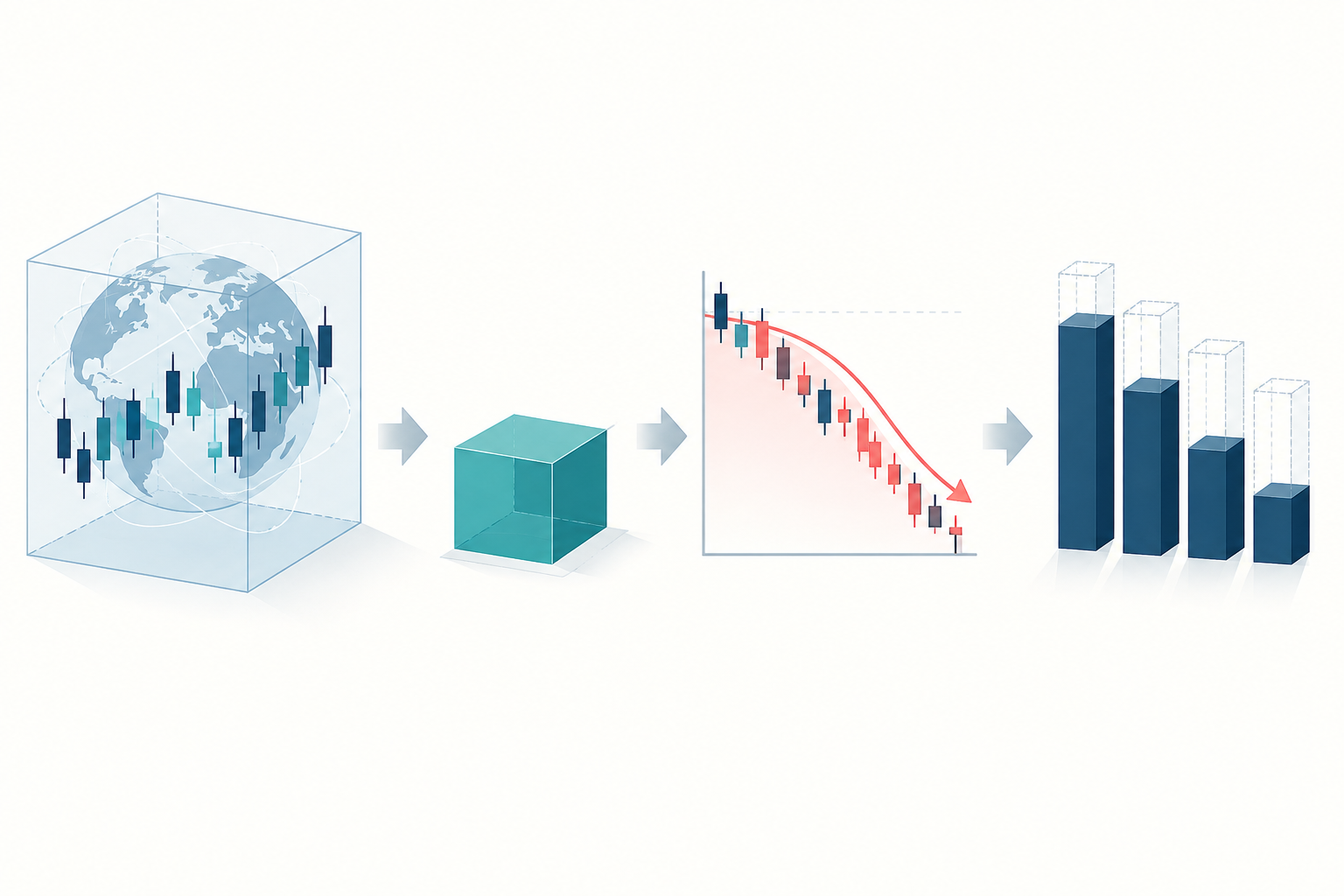
Equity and available margin change as prices move
Providers use terms such as balance, equity or net asset value (NAV), used margin, available margin, and margin level. A common teaching formula is equity = balance + unrealized profit or loss, and available margin = equity − used margin. The exact items included, conversion method, and field names are account-specific. OANDA's U.S. statement, for example, defines its own account and margin fields; its definitions should not be assumed to match another provider's platform.
An adverse move can reduce equity while used margin remains similar or changes with current rates and currency conversion. Available margin then falls, and a margin-level indicator may move closer to a provider's close-out threshold. A favorable move can increase equity, but does not guarantee that a position stays open: rates, concentration tiers, trading hours, and account rules can also change.
A close-out threshold is not universal
The amount required to open a position, the amount needed to keep it open, a warning level, and the point where positions may be closed are distinct concepts. For a hypothetical illustration, suppose a contract requires equity to stay above 50% of $5,500 used margin. That threshold would be $2,750. If equity began at $10,000 and only price losses changed it, the arithmetic distance to the threshold would be $7,250. This does not say that a real provider waits for that loss, sends a call first, or closes positions in a particular order.
OANDA Corporation's U.S. materials describe specific calculations and close-out conditions for its accounts, including v20 procedures. They are an example of one provider's terms, not an industry standard. A provider may close one position, several positions, or all positions, and may use current bid or ask prices plus its own conversion method. Gaps, thin liquidity, unavailable trading sessions, and slippage can affect execution. Read the agreement and the platform's definitions instead of relying on the generic phrase “margin call.”
Costs and product rules matter too
Spread, commission, currency-conversion charges, and overnight financing affect account equity but are separate from an initial margin estimate. A stop order is not a guarantee of a fill at its trigger. If price gaps or liquidity is limited, execution can be worse than the assumed stop price. The CFTC's advisory is specifically about U.S. OTC forex: it says a 2% margin requirement can support a $100,000 position with $2,000, explains that leverage magnifies gains and losses, and warns that losses can exceed initial margin. These U.S. OTC statements should not be generalized to every jurisdiction or product.
Do not apply retail OTC forex percentages directly to exchange-traded currency futures. Futures use exchange-defined contract multipliers, tick values, and clearing margin schedules; initial and maintenance margin are not necessarily a fixed percentage of cash notional. CFDs can also have separate product rules even when their quotes look like currency pairs. For quantity and price-risk calculations, see forex lot size, pip value, and position sizing; for transaction costs, see forex spread versus commission.
Check the exact account before placing an order
Identify the provider's legal entity and regulator, the product, its unit or contract size, notional calculation, and account currency. Then check opening and maintenance requirements, size tiers, how other positions offset or add margin, the equity formula, warning and close-out levels, liquidation order, overnight financing, conversion charges, and stop execution rules. Check negative-balance terms and customer protections in the agreement; do not infer them from a promotional page.
A lower margin rate means less collateral under that particular calculation. It does not make the underlying exchange-rate move smaller or the position inherently safer. If a trade only fits the account under a headline maximum-leverage number, there may be little room for an adverse move or a rate change. Calculate price exposure and likely costs separately, then compare them with account equity and product limits. All figures here are hypothetical and educational, not a current margin quote or trade recommendation.
Common questions
Q1[
{"question":"Is margin the amount I can lose?","answer":"No. Margin is a collateral requirement under the provider's rules. A position's loss depends on its size and price movement, while costs, execution, and applicable customer protections also affect the result."}, {"question":"Does 20-to-1 leverage mean a position can lose only 5%?","answer":"No. It describes a simplified relationship between exposure and supporting equity. Price losses can reduce equity substantially; margin and liquidation rules depend on the contract."}, {"question":"Why can required margin change when quantity stays fixed?","answer":"The provider may change its rate, apply size tiers, convert exposure at a moving exchange rate, or account for other positions and current product conditions."}, {"question":"Are forex and currency-futures margin calculated the same way?","answer":"Not necessarily. Futures use exchange contract specifications and clearing schedules; retail OTC forex and CFDs follow their own provider and jurisdiction terms."} ]
Sources and further reading
Report an issue
We’ll prepare an email with this article link. Mark receives the report only after you send it
Quick check
Read the guide? Check yourself with 3 questions
Question 01
A hypothetical $110,000 position has a 5% margin rate. What is the simple margin estimate?
Choose an answer to see the explanation
Options glossary
Clear definitions of essential option terms, from calls, puts, and option chains to IV, Greeks, open interest, and max pain
Browse the options glossary