

Housing Starts, Building Permits, and Completions: Read the Pipeline
Learn what U.S. building permits, housing starts, units under construction, and completions count, how Census SAAR works, and why the estimates do not move one for one.
In this guideWhat do building permits, starts, and completions measure?
Short summary
The Census Bureau’s New Residential Construction release reports several points in a housing project’s path: units authorized by permits, authorized units not yet started, starts, units under construction, and completions. These are related measures, not interchangeable counts of one perfectly matched group of homes. A permit is approval to proceed, a start is tied to excavation for a foundation, and completion is a later construction milestone. All examples in this guide are hypothetical; no current release figures are quoted.
What do building permits, starts, and completions measure?
A building permit is an authorization from a local jurisdiction to proceed with a construction project. In the Census Bureau’s monthly data, the permit measure is the estimated number of housing units authorized, not simply the number of permit documents or buildings. A permit says that a project has received local approval. It does not say that excavation has begun, that the project will be built exactly as authorized, or that every approved unit will be completed. The Census Bureau’s [Building Permits Survey definitions]({source:censusNrcBpsDefinitions}) distinguish authorization from later construction stages.
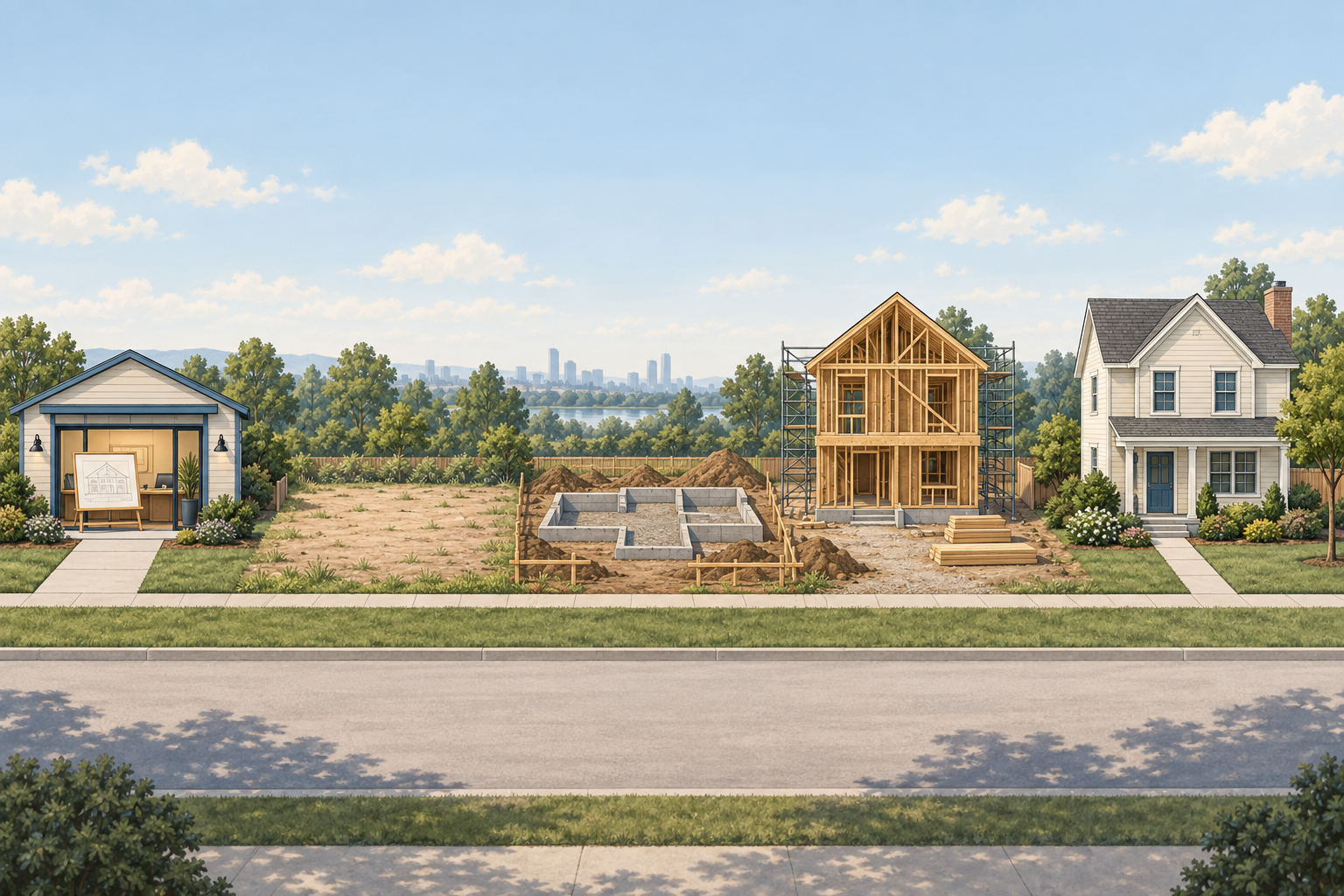
A housing start is counted when work reaches a defined point: excavation begins for the footings or foundation. It is not the date a builder announces a project, orders materials, closes on land, or obtains a permit. Units under construction have started but are not yet counted as complete. A completion is measured under a separate Census definition, so monthly completions usually reflect work that began in an earlier period. These are stage measures of housing units, not a direct tally of all buildings currently on construction sites.
The New Residential Construction release presents the measures together so readers can examine the flow of new privately owned housing through the pipeline. The [Census overview]({source:censusNewResidentialConstruction}) describes the published stages and explains that permits, starts, and completions are assembled from two related surveys. Reading the stages side by side can help describe activity, but dividing one month’s starts by that month’s permits does not show what share of that exact permit group eventually became homes.
How does Census compile the construction pipeline?
The Building Permits Survey (BPS) estimates housing units authorized by permits from a sample of permit-issuing offices. The Survey of Construction (SOC) estimates when sampled permitted units are started and completed, and also estimates construction in places that do not require permits. In permit areas, Census follows selected permits through the construction process. In non-permit areas, field representatives look for new construction activity. The monthly release combines the permit and construction information into national and regional estimates. See the [Survey of Construction methodology]({source:censusSurveyOfConstructionMethodology}) and the Bureau’s [overview of new residential construction]({source:censusNewResidentialConstruction}).
That combination matters because starts and completions are not calculated by taking the current month’s permit count and applying a fixed conversion percentage. Census uses survey observations and ratio adjustments that account for permit offices, housing type, timing, follow-up, and construction in non-permit areas. Some units can start before a permit is recorded; some authorizations remain unstarted; some projects change design or unit count after approval. The [Census explanation of relationships between permits, starts, and completions]({source:censusNrcRelationshipsPermitsStartsCompletions}) describes several reasons the series can diverge.
The statistics count housing units rather than treating every building as a single unit. An apartment building with many units can contribute many authorized units, starts, or completions. The published scope is new privately owned housing, including eligible site-built, prefabricated, panelized, sectional, and modular homes; it excludes HUD-code manufactured homes and also excludes categories such as group quarters and units created by converting an existing structure. Always confirm the population and geography before comparing the figures with another housing series. The [BPS definitions]({source:censusNrcBpsDefinitions}) and [SOC definitions]({source:censusNewResidentialDefinitions}) document these boundaries.
When does Census count a unit as started or completed?
For Census purposes, construction starts when excavation begins for a building’s footings or foundation. That definition gives the monthly starts measure a specific threshold. Site preparation, permit issuance, financing, or a builder’s public announcement can happen earlier, but none by itself makes a unit a start under the SOC definition. For a multifamily building, all of its housing units are counted as started when excavation for that building’s footings or foundation begins. A single excavation event can therefore add many units to the starts estimate. The [SOC definitions]({source:censusNewResidentialDefinitions}) set out this counting rule.
“Under construction” is a separate status for housing units that have started but are not yet complete. It represents an in-progress inventory, while starts and completions are monthly flows. A change in the number under construction depends on new starts entering the pipeline and units leaving it through completion or other status changes. It should not be read as another name for this month’s starts.
Census generally defines a house as completed when all finished flooring has been installed, including carpeting where it replaces finished flooring. If a building is occupied before construction is fully finished, Census classifies it as complete at occupancy. In privately owned buildings with two or more units, all units are counted as completed once at least half of the units are occupied or available for occupancy. These rules make completion a statistical milestone; they do not mean every unit reached the same physical finish on the same day. See [Census’s completion and construction-stage definitions]({source:censusNewResidentialDefinitions}).
Why don’t permits, starts, and completions line up one for one?
A permit is permission to build, not a promise to build. A project can be redesigned, delayed, or abandoned after approval. Census also reports units authorized but not yet started, which makes part of the gap between permits and starts visible as pipeline inventory. The [Census permit-start-completion discussion]({source:censusNrcRelationshipsPermitsStartsCompletions}) notes abandonment before a start and even after construction has started; it also describes design changes that can alter a multifamily project’s final number of units.
The time periods differ as well. Some starts in a month correspond to permits issued earlier; some permitted units have not yet reached excavation; and some starts occur in areas without permit requirements or before the permit is captured. Completions generally follow starts after a construction interval, rather than arriving in the same month. Units under construction and authorized-but-not-started units are inventories that connect the stages across time. Thus, a same-month gap between permits and starts is not a cancellation rate, and the ratio of completions to starts in a month is not the completion probability for that month’s new starts.
Measurement and classification also matter. Local permit records and the construction survey are separate data collection systems. A permit can be classified differently after field follow-up, builders can revise plans, and sample estimates carry error. Permit totals can also be revised on a schedule distinct from starts and completions. These are reasons to compare definitions, reference months, units, and release vintages before interpreting a gap as a sudden change in demand or construction.
What can a hypothetical construction pipeline show?
Suppose, purely as a teaching example, that a hypothetical group contains 100 housing units authorized by permits. After a defined follow-up period, imagine that 70 have reached foundation excavation, 20 remain authorized but not started, and 10 were abandoned before work began. The 70 starts do not represent a universal 70% conversion rate. They describe one invented group under one invented follow-up window; a different project mix or period could produce different outcomes.
| Hypothetical status after follow-up | Housing units | What the status means |
|---|---|---|
| Authorized and started | 70 | Excavation for footings or foundation has begun |
| Authorized, not started | 20 | A permit exists, but excavation has not begun by the example’s cutoff |
| Abandoned before a start | 10 | The approved project did not reach the start milestone in this example |
| Total originally authorized | 100 | The example’s starting group, not a Census release figure |
Now suppose a later snapshot shows that 45 of the 70 started units have met the completion definition while 25 remain under construction. That illustrates why starts and completions need not match in any particular month. It does not mean the Census monthly series follows a single closed cohort exactly as shown here; the real estimates use samples, adjustments, non-permit-area observations, and reference periods that can overlap.
For a separate hypothetical annual-rate example, suppose a seasonally adjusted monthly estimate is 8,000 starts. Multiplying 8,000 by 12 gives a SAAR of 96,000 units. This arithmetic expresses the month’s adjusted pace at an annual rate. It does not predict that 96,000 units will actually start over the next year, nor does it describe 96,000 starts in that one month. No number in either example is a current Census estimate or forecast.
<!-- learn:illustration -->
What does the SAAR for housing starts mean?
Census seasonally adjusts many monthly housing series to reduce recurring calendar and seasonal patterns that can make one month difficult to compare with another. It then presents many adjusted series as seasonally adjusted annual rates (SAAR). The calculation is: seasonally adjusted monthly estimate × 12. For example, a hypothetical adjusted monthly pace of 8,000 starts corresponds to a SAAR of 96,000. The annual-rate format makes a month’s pace easier to compare with annual totals; it does not turn a monthly observation into a projection. The [Census definition of SAAR]({source:censusNrcBpsDefinitions}) explicitly distinguishes the annualized rate from a forecast.
Seasonal adjustment estimates recurring patterns from past and present data. It does not remove every weather shock, work stoppage, financing change, or other unusual event. A seasonally adjusted number and a not-seasonally-adjusted number answer different comparison questions. If a chart mixes them, or compares an annualized adjusted rate with a raw monthly count, the apparent difference may come from the measure rather than from the construction pipeline.
The table heading matters: check whether the figure is seasonally adjusted, expressed at an annual rate, and reported in housing units. Do not multiply a SAAR by 12 again; that would annualize it twice. Do not describe a SAAR of 96,000 as the number of units completed in one month or as a promised total for the coming year. It is a standardized description of the adjusted pace in the reference month.
How certain are the estimates, and when can they change?
Census builds New Residential Construction estimates from samples and follow-up procedures, not from a complete count of every project. Sample estimates can differ from what a full census using the same definitions would have produced. The SOC methodology discusses both sampling error and nonsampling error, including coverage, response, recording, processing, and imputation issues. A point estimate is useful, but it is not an exact count with no uncertainty. The [methodology and reliability notes]({source:censusSurveyOfConstructionMethodology}) explain these limits.
Preliminary values can be revised as more reports arrive and the survey process is updated. Census describes revisions to recent months for authorized-but-not-started units, starts, units under construction, and completions; seasonal factors can also lead to broader historical revisions. Permit estimates and SOC construction estimates have related but distinct procedures. If precision about what was known at a particular time matters, preserve the release vintage instead of silently replacing an earlier estimate with a later one.
The Census Bureau posts a [release schedule]({source:censusNrcReleaseSchedule}) for New Residential Construction and related releases. Check it for current timing and revision notes rather than relying on a remembered calendar. A first estimate and its later revision are both part of the data record; short-term differences can reflect updated information as well as actual changes in construction activity.
How should readers interpret a housing-construction headline?
Start by identifying the stage. Permits are authorizations, starts mark the excavation threshold, under-construction figures describe in-progress units, and completions mark a separate milestone. Next check whether the reported number counts housing units or structures, whether it is national or regional, and whether it is seasonally adjusted or shown as SAAR. Those details determine what the number can and cannot answer.
Then ask whether the comparison is a same-month snapshot or a linked group of projects. The regular monthly report is useful for tracking the pace and composition of activity, but its stages are not a one-to-one project ledger. A permit decline is not automatically a same-month decline in starts; a high number of starts is not a count of homes that will finish immediately. Include the release vintage and consider sampling uncertainty when the claimed difference is small.
Housing construction is one part of economic activity, not a complete measure of housing demand, affordability, or residential investment. For a broader production measure, see real GDP growth rates and industrial production versus capacity utilization. To understand one financing benchmark that can affect housing decisions, read mortgage rates and 10-year Treasury yields. These comparisons add context; none turns permits or starts into a forecast of home prices or mortgage rates.
Common questions
Q1Does every building permit become a housing start?
No. A permit authorizes construction, but work may be delayed, redesigned, or abandoned. Some units are still authorized but not started at a given cutoff, while starts may include non-permit-area activity or units that began before a permit was recorded.
Q2Is a housing start the same as a building being finished?
No. Census counts a start when excavation begins for the footings or foundation. The unit may then remain under construction before it meets the separate completion definition.
Q3Does SAAR predict how many homes will be built next year?
No. SAAR is the seasonally adjusted estimate for one month multiplied by 12 to express an annualized pace. It is a description of that month’s rate, not a forecast or promise of next year’s construction. ---
Sources and further reading
Report an issue
We’ll prepare an email with this article link. Mark receives the report only after you send it
Quick check
Read the guide? Check yourself with 3 questions
Question 01
When does Census count a housing unit as a construction start?
Choose an answer to see the explanation