

Forex Carry Trade: Rate Differentials, FX Risk, and Leverage
Learn how a forex carry trade combines an interest-rate gap with currency exposure, why forward pricing is different, and how leverage can turn a small yield pickup into a larger loss.
In this guideWhat a currency carry trade holds
Short summary
A forex carry trade seeks the financing gap between a higher-yielding and a lower-yielding currency, but exchange-rate moves, costs, and leverage determine the result.
What a currency carry trade holds
A currency carry trade usually pairs a long position in a higher-yielding currency with a short position in a lower-yielding funding currency. The position seeks income from the difference between the two currencies' financing or interest rates while leaving the investor exposed to the exchange rate. Researchers do not use one universal definition: some reserve the term for borrowing one currency to fund another asset, while others include spot, forward, futures, and other positions that create the same long-high-rate/short-low-rate exposure. The Federal Reserve's historical overview describes both the broader definition and the role of margin and leverage.
The important distinction is between the source of the carry and the total return. A rate or rollover credit is one cash-flow component. The currency pair can move against the position by more than that carry, and spreads, financing terms, conversion, and margin rules can change the result. A trade is not profitable merely because its long currency has a higher policy rate.
An interest-rate gap is only a starting estimate
A central-bank policy rate is not automatically the rate a trader earns or pays. Short-term funding conditions, the instrument, value dates, collateral, dealer or broker pricing, and transaction costs all matter. In a rolling retail product, the broker may post a provider-specific debit or credit; OANDA's published financing page is an example of one provider's method, not a universal schedule. See the guide to forex rollover adjustments before equating a quoted rate difference with the amount on an account statement.
The gross yield pickup also says nothing by itself about the currency's expected direction. The BIS Quarterly Review published in December 2024 described a historical period after the August 2024 carry unwind: higher FX volatility reduced incentives to rebuild positions, and the currencies with the largest interest-rate gaps to the US dollar also carried greater currency-depreciation risk in the review's analysis. That is a dated observation, not a current ranking or a rule that every high-yield currency must fall.
Annualized carry and the actual holding period must use a consistent basis. The earlier estimate simply treats three months as one quarter of a year, while settlement may follow a contract’s day-count convention and value dates. Weekends, local holidays, and reset financing rates can change the number of accrued days and the amount posted. Check whether the quoted rate is simply annualized, whether it uses a 360- or 365-day denominator, and how holidays are adjusted; reconcile the estimate with the statement for the same period and currency.
Do not assume a broker’s financing adjustments for long and short positions are exact opposites. Direction-specific rates, provider funding costs and markups, contract units, value-date calendars, and holding days can all differ. Do not reverse the sign of one side’s rollover credit to estimate carry on the other side. Check the dated product schedule for each direction and reconcile it with the posted amount on an actual account statement.
A hypothetical carry calculation can still lose money
Suppose a hypothetical position has 100,000 US dollars of currency exposure and an estimated annual net carry differential of 3 percentage points. A simple three-month estimate is 100,000 × 0.03 × 3/12 = 750 dollars before fees, changing rates, compounding, and provider-specific financing. The calculation is a scale illustration, not a promised rate or a live quote.
Now suppose the higher-yielding currency weakens by 1% against the funding currency during the same period. On this simplified notional, the FX loss is about 100,000 × 0.01 = 1,000 dollars. Combining that approximate price loss with the 750-dollar gross carry leaves about minus 250 dollars before costs. The currency movement is only one percentage point, yet it more than erases the assumed carry. Exact P&L depends on the pair's quote convention, the changing notional, entry and exit prices, and the instrument's cash flows.
Do not count the same financing twice. If a broker's posted rollover already represents a financing adjustment, adding the policy-rate difference again would overstate the return. Keep price P&L, booked rollover or financing, spread and commission, and account-currency conversion in separate lines so the estimate can be reconciled with a statement.
The direction of a currency pair also matters for price P&L. A/B usually quotes the price of quote currency B for one unit of base currency A. If A is the higher-yielding currency, buying A/B benefits from a rise in the pair. If B is the higher-yielding currency, the same economic exposure may instead require selling A/B. Calculate contract P&L from position size, price change, and contract multiplier, then convert from quote currency to account currency. The earlier 1% calculation is a simple approximation on exposure already converted to dollars.
Under the same assumptions, an adverse exchange-rate move of 750 ÷ 100000 = 0.75% would erase the gross carry before costs. This is neither a safe boundary nor a probability estimate; it changes with booked financing, holding days, spreads, contract size, and currency conversion. Recalculate in the position’s direction using expected carry and entry and exit costs in the same account currency.
A hedged forward is not an extra carry bonus
Buying the higher-rate currency in spot and hedging its future value with an FX forward changes the question. Covered interest parity links the forward rate to the spot rate and the two interest rates under matched assumptions. In that simplified relationship, the forward points normally offset the rate advantage when the currency exposure is hedged; they are not a second, risk-free source of carry. The FX forward-points guide explains the quote and its limitations.
Real market quotes can depart from a textbook parity calculation because of the cross-currency basis, bid-offer spreads, credit and liquidity conditions, collateral, and balance-sheet costs. The BIS explains both the no-arbitrage benchmark and how actual FX-swap pricing can reflect these frictions. An unhedged carry trade keeps exchange-rate risk; a fully hedged trade has different forward cash flows and costs. Comparing the interest-rate gap with forward points without aligning dates, quote sides, and transaction terms can count incompatible measures.
A hypothetical CIP calculation makes the role of forward points concrete. With spot at 1.1000 USD/EUR, T = 0.25 years, a 5% simple USD rate, and a 3% simple EUR rate, the simplified relation is F = S × (1 + rUSD × T) / (1 + rEUR × T). This gives F ≈ 1.1000 × 1.0125 / 1.0075 = 1.10546 USD/EUR, so F−S ≈ +0.00546. It assumes matched notionals, dates, and day counts with no basis, credit costs, or bid-offer spread. This is an explanatory calculation, not a retail quote or forecast of future spot.
Leverage changes the loss relative to equity
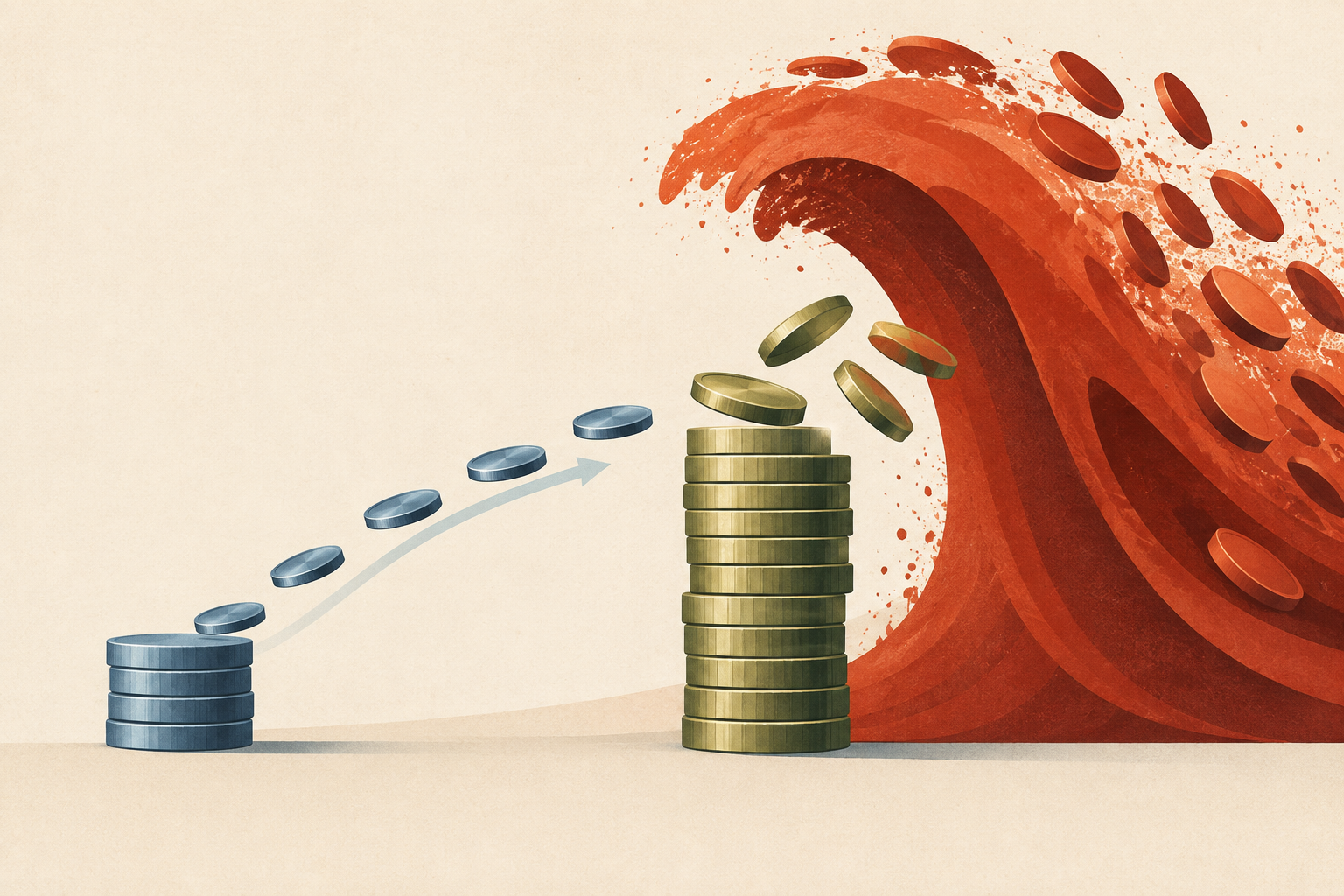
Imagine the same 100,000-dollar exposure is supported by 10,000 dollars of equity, a hypothetical 10-to-1 exposure-to-equity ratio. A 1% adverse currency move is roughly a 1,000-dollar loss, or 10% of that starting equity, before carry and costs. The 750-dollar illustrative gross carry is 7.5% of equity, but that ratio does not make it a likely or stable return. After the assumed 1% currency decline, the simplified net result is a 250-dollar loss, or 2.5% of starting equity, before charges.
Leverage can make a modest market move large relative to the capital supporting the position. If equity approaches a provider's maintenance threshold, the trader may need to add funds or reduce exposure; a fast move or gap can produce a worse exit than a displayed mark. Margin is collateral for the position, not a cap on losses, and the actual threshold and close-out sequence depend on the product and provider. The forex margin and leverage guide covers those mechanics separately.
Why carry positions can unwind quickly
Carry positions can become crowded when realized volatility has been low and many investors hold similar long and short currency exposures. A policy surprise, a shift in expected rate paths, or a jump in volatility can change both the expected interest differential and the amount of risk investors are willing to hold. If leveraged traders reduce exposure at the same time, they may need to buy back the funding currency and sell the higher-yielding currency, reinforcing the initial move.
A May 2026 BIS bulletin analyzes how significant short positions in funding currencies can amplify the exchange-rate response to monetary tightening when previously accumulated leveraged carry positions unwind. The result is conditional on positioning and the event; it is not a forecast that every rate increase causes a crash. The 2024 BIS review also documents how volatility affected incentives to rebuild positions after that period's unwind. Together, these sources support a practical lesson: a carry estimate should include an adverse currency move and an exit-under-stress scenario, not just a quiet-market yield calculation.
Under stress, price losses and exit costs may worsen together. A volatility shock can weaken the purchased currency and strengthen the funding currency, while one-sided orders reduce depth and widen spreads. Falling equity or higher collateral requirements may force traders to cut positions; poor execution can then prompt further selling. A scenario that moves FX against the position but leaves financing and spreads at quiet-market levels can understate the loss. Stress price, financing, trading costs, and collateral together.
Match the instrument and costs before comparing trades
A deliverable currency deposit, a rolling spot product, a CFD, an outright forward, and an exchange-traded futures contract do not book the same cash flows. A retail rollover credit is set by the provider's contract and schedule. A forward embeds the rate differential in its agreed exchange rate, while a currency future has its own contract, settlement, and margin mechanics. An instrument label such as swap or funding does not make the products interchangeable.
For each quote, record the exact pair and direction, exposure or contract size, entry and exit dates, financing or rollover convention, forward points if relevant, spread and commission, account currency, and conversion rate. Check whether the quoted percentage is annualized and whether it is gross or net of the provider's adjustment. Compare the same holding period and quote side; otherwise one trade may appear cheaper only because its costs are shown in a different unit.
A practical checklist for a carry estimate
Before treating an interest-rate gap as a possible return, write down the assumptions rather than starting from the largest advertised yield. Identify which currency is long and which is short, what instrument creates each exposure, and how the position earns or pays financing. Use a dated provider schedule or executable quote for an account-level estimate; do not substitute a central-bank target rate when the contract uses a different rate.
Then calculate at least three separate cases: a stable exchange rate, a move against the higher-yielding currency, and a stressed exit with wider spreads or reduced liquidity. Show carry, FX P&L, transaction costs, and margin usage separately. Finally, ask whether the result depends on leverage, a single rate forecast, or an assumption that many investors can exit at once without moving the market. These checks explain the mechanics; they do not identify a suitable currency pair or predict a trade's outcome.
Common questions
Q1Is a forex carry trade just earning interest?
No. Interest or rollover is one component. The position also has exchange-rate exposure, and execution, financing, conversion, and margin costs affect the result.
Q2Does a higher interest rate mean a currency will depreciate?
Not automatically. Exchange rates respond to expectations and many other factors. Historical patterns do not determine the next move, and a high rate is not a forecast.
Q3Are forward points extra income on top of carry?
Usually not when the currency exposure is hedged. Under covered interest parity, forward pricing reflects the interest-rate gap; basis, credit, liquidity, and execution conditions can change the quote.
Q4Can leverage make a carry trade safer because the yield is positive?
No. Leverage increases exposure relative to equity. A relatively small adverse exchange-rate move can outweigh accumulated carry and may trigger additional margin or a forced reduction. Today’s policy-rate gap is not guaranteed to equal carry over the full holding period. Markets may price an expected central-bank path into spot and forward rates before a decision occurs, so FX P&L can arrive before the policy change. Record the rate path and announcement dates relevant to the trade horizon instead of holding one rate constant each day. Compare the result if the differential narrows or reverses. This tests sensitivity to assumptions; it does not confirm a rate or currency forecast.
Sources and further reading
Report an issue
We’ll prepare an email with this article link. Mark receives the report only after you send it
Quick check
Read the guide? Check yourself with 3 questions
Question 01
What does the 3-percentage-point differential in a carry estimate represent?
Choose an answer to see the explanation