

How DeFi Crypto Loans Work: Collateral, LTV, Health Factor, and Liquidation
Learn how crypto collateral supports a DeFi loan, why LTV differs from a liquidation threshold, how Aave calculates health factor, and what can change a position before liquidation.
In this guideWhat a collateralized DeFi loan does
Short summary
A DeFi collateral loan lets a borrower lock supported crypto assets in a protocol and borrow another asset against them. The loan can become unsafe even when the borrower makes no new transaction: collateral prices can fall, debt can grow with interest, or protocol parameters can change. Loan-to-value (LTV), liquidation thresholds, and health-factor rules are protocol-specific, so a dashboard number is meaningful only when you know how that market defines it.
What a collateralized DeFi loan does
In an overcollateralized loan, a borrower supplies an eligible asset to a lending protocol and receives a different asset as debt. The collateral remains subject to the protocol’s rules while the debt is open. It generally cannot be freely withdrawn if doing so would leave too little value to support the loan. Once the debt and accrued interest are repaid, the borrower can withdraw collateral that is no longer needed to secure another open position.
This differs from an unsecured loan: the protocol does not rely only on a promise to repay. It relies on collateral that can be sold, seized, or otherwise used under the protocol’s liquidation rules if the account no longer meets its requirements. Aave describes its V3 borrowing model as overcollateralized and requires users to supply collateral before borrowing. Compound III also accepts supported collateral assets to establish borrowing capacity, but its accounting and liquidation design use different factors.
The protocol does not treat every wallet balance as collateral automatically. An asset must be supported in the specific market, and the account may need to enable it as collateral. Network, market, token contract, and protocol version all matter. A token with the same ticker on another chain may not be the same asset or have the same risk parameters. Aave’s introduction to Aave V3 explains its supply-and-borrow flow; the collateral-status guide explains that a supplied balance can be enabled or disabled for collateral use.
Position LTV is not the same as a protocol’s limit
Loan-to-value is a ratio that compares debt with collateral value. A simple way to describe a position is:
Position LTV = current debt value ÷ eligible collateral value
If an account has $1,000 of debt backed by $2,000 of eligible collateral, its position LTV is 50%. If debt stays the same while collateral falls to $1,500, position LTV rises to about 66.7%. If the borrowed asset itself changes in price, the debt’s value can move too.
A protocol’s LTV parameter is often a borrowing limit used when a loan is opened or increased. For example, if a hypothetical market permits borrowing up to 75% of the eligible value of $2,000 in collateral, its arithmetic ceiling would be $1,500 before other limits. That ceiling is not a recommended borrowing amount and does not guarantee that a position remains safe after prices move.
The terms can differ across protocols. Aave distinguishes LTV, which constrains borrowing power, from a liquidation threshold used in its health-factor calculation. Compound III documents a borrow collateral factor for borrowing capacity and a separate liquidation collateral factor for liquidation eligibility. Its documentation also cautions that failing the borrowing-capacity check does not, by itself, mean an account is liquidatable. See the protocol-specific rules in Aave’s borrowing guide and Compound III’s collateral and borrowing documentation.
What changes a position after you borrow
Collateral and debt values can change independently. A drop in collateral price lowers the value supporting the loan. A rise in the borrowed asset’s price can increase the debt’s value when measured in a common unit. Interest can also add to the amount owed, even if the borrower has not borrowed more. With multiple collateral assets, the protocol may apply different risk weights or eligibility rules to each one.
Protocol price feeds matter because the contract does not necessarily use the last price shown on an exchange or in a wallet. A market may use an oracle value, apply asset-specific rules, or update prices on a schedule. During volatile markets, displayed data and the value used by a contract can differ. The account’s condition can therefore change between checks or transactions.
Some interfaces show a single “health” number; others show collateral factors, account liquidity, or a borrowing limit. These labels are not interchangeable. A position can be unable to borrow more while still not being eligible for liquidation. Conversely, a metric that looks comfortable at one price can deteriorate as collateral values fall or interest accumulates.
With more than one collateral asset, adding token quantities together would not describe the account’s risk. Aave uses a weighted average liquidation threshold in its health-factor formula. In a hypothetical example with $1,000 of one collateral at an 80% threshold and $1,000 of another at 70%, equal collateral values produce a 75% weighted average. The threshold-adjusted collateral amount in the formula is then $2,000 × 75%, or $1,500, before it is compared with debt. Actual asset parameters and recognized values are market-specific; another protocol can use a different calculation.
A hypothetical health-factor calculation
Aave defines health factor as collateral value multiplied by the weighted average liquidation threshold, divided by total borrow value. In a one-collateral example, suppose an account supplies 2 units of a token at a hypothetical price of $1,000 each. It borrows $1,000 of another asset. For illustration only, assume an initial LTV parameter of 75% and a liquidation threshold of 80%; these are invented inputs, not current parameters for a named market.
The collateral is worth $2,000, so the starting position LTV is 50%. The maximum borrow implied by the assumed 75% LTV would be $1,500, before any other market constraints. Under the assumed 80% liquidation threshold, health factor is:
($2,000 × 0.80) ÷ $1,000 = 1.60
Now suppose the collateral price falls 35%, reducing collateral value to $1,300, while accrued interest raises the debt to $1,010. The health factor becomes about 1.03:
($1,300 × 0.80) ÷ $1,010 ≈ 1.03
If the collateral falls further to $620 per unit, its total value is $1,240 and the same illustrative calculation is about 0.98:
($1,240 × 0.80) ÷ $1,010 ≈ 0.98
That last value is below 1. Aave’s current help page describes a health factor below 1 as a liquidation-risk condition for Aave positions. The example does not predict when a real transaction will execute: market prices, debt accrual, protocol rules, oracle updates, and transaction ordering all matter. Aave’s health-factor and liquidation explanation gives the protocol formula and notes that there is no universally safe health-factor value.
What liquidation can do to collateral
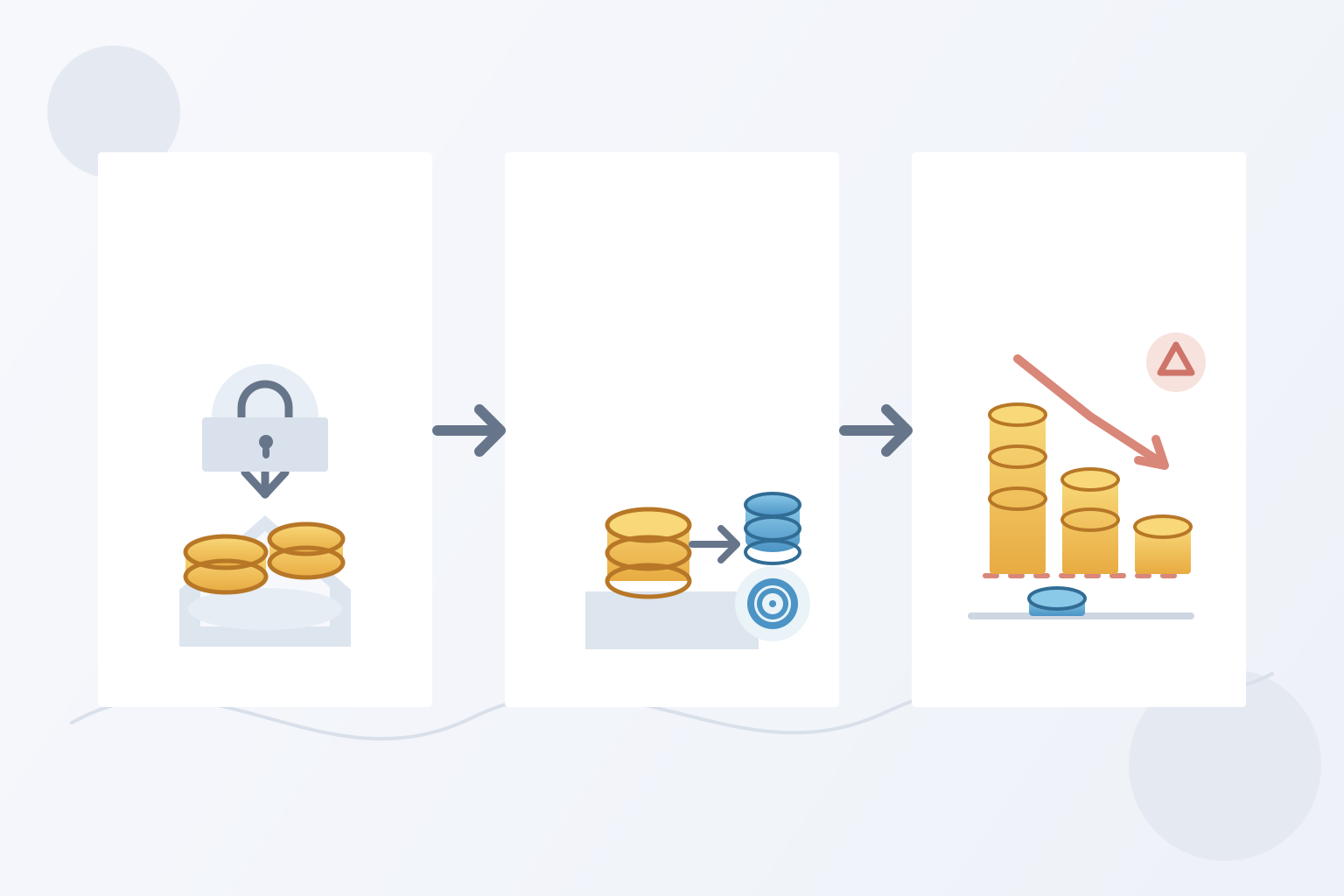
Liquidation is a protocol-defined response to an account that crosses its eligibility rule. In many lending markets, a liquidator repays some or all of a borrower’s debt and receives collateral according to a protocol-set bonus, discount, or penalty. The borrower can lose more collateral value than the amount of debt repaid. Whether liquidation is partial or full, how much can be repaid, and what fees apply depend on the protocol, asset, market, and current configuration.
Aave describes eligible liquidations as permissionless: a network participant can submit one when the account’s health factor is below the protocol threshold. Its rules determine the repayable amount and the collateral delivered, including any liquidation bonus. Compound III uses a different design. Its documentation distinguishes the borrow collateral factor from the liquidation collateral factor and describes an absorb process in which the protocol takes an underwater account’s collateral and repays the debt from protocol reserves; the former borrower receives value under Compound’s liquidation-factor rules. See Compound III’s liquidation documentation.
These are examples of how two protocols implement lending mechanics, not a universal description of every DeFi loan. Some protocols can pause, change risk parameters through governance, use different liquidation paths, or depend on outside keepers and interfaces. Read the rules for the exact chain and market whose contract will hold the collateral.
Interest can increase the debt without a new borrow
Borrowed balances usually accrue interest. The rate may be fixed for a defined period, change over time, or respond to market utilization, depending on the protocol and asset. Aave says its borrow rates are dynamically determined by factors such as utilization and governance parameters. As interest accrues, the debt term in a collateral ratio or health-factor calculation can rise even if the collateral price is unchanged.
For example, if a $1,000 debt balance grows to $1,020 while eligible collateral remains worth $1,500, position LTV rises from about 66.7% to 68%. This arithmetic does not assume a particular annual rate or time period. Actual accrual depends on the contract’s rate model, transaction timing, asset precision, and market conditions. The Aave borrowing guide says rates can adjust with utilization and that interest begins accruing after the borrow transaction.
Collateral may also have opportunity costs or operational limits. A supplied asset can stop being available for withdrawal while it secures debt. Compound III states that its collateral assets do not themselves earn interest in the protocol, while the treatment of supplied collateral differs elsewhere. Do not assume that collateral earns yield, that the borrowed asset will hold a fixed value, or that expected yield will exceed borrowing costs.
Risks the ratio does not capture
LTV or health factor summarizes selected price and debt inputs; it does not measure every way a loan can fail. Smart-contract bugs, permission or governance changes, oracle outages, chain congestion, bridge or wrapped-token problems, and a collateral or debt token losing its expected value can all affect the outcome. A stablecoin used as debt can trade away from its target; a collateral token may become less liquid just when many borrowers need to repay or sell.
Execution adds another layer. A borrower may need to submit a repayment or add collateral before a threshold is crossed, but network fees, wallet access, insufficient balances, or a congested chain can delay the transaction. A dashboard alert cannot guarantee that a transaction will be included in time. Conversely, an interface can be stale or unavailable while the on-chain contract continues to apply its rules.
Leverage also magnifies the consequences of a price move. Borrowing against a volatile token to buy more of that same token can increase both exposure and liquidation sensitivity. Borrowing one asset against another can create a mismatch: the collateral may fall as the debt asset rises. Neither a high displayed health factor nor a large collateral balance removes smart-contract, market, or operational risk.
Read the market rules before opening a loan
Before supplying collateral or borrowing, check the exact protocol, chain, market, and asset contracts. Confirm whether the asset is supported and enabled as collateral, how the protocol defines borrowing capacity and liquidation eligibility, which price source it uses, and whether the displayed metric is current. Read the borrow rate and how it can change, the minimum or maximum position limits, withdrawal restrictions, liquidation bonus or penalty, and any governance process that can update parameters.
Use a hypothetical price decline and debt increase to understand how the position changes; do not treat the protocol’s maximum borrow as a target. Check what a repayment or collateral addition would require in practice, including access to the borrowed asset, network fees, and time to submit a transaction. Recheck the protocol’s current documentation because parameters can differ by asset and market and may change after governance decisions.
This guide explains lending mechanics, not whether a loan is suitable or how much a person should borrow. For the separate mechanics of exchange-traded perpetual positions, see the crypto perpetual liquidation guide. To review the token permissions that may be involved in supplying or repaying assets, see crypto token approvals and allowances.
Common questions
Q1Is LTV the liquidation threshold?
No. LTV commonly sets how much a position may borrow, while a liquidation threshold determines when a protocol may liquidate it. Protocols can use other names and calculations, so check the exact market’s definitions.
Q2Does a health factor below 1 mean liquidation already happened?
Not necessarily. In Aave’s documentation, a health factor below 1 makes a position eligible for liquidation; a liquidator still has to submit a transaction that satisfies the protocol’s rules. Execution timing and the amount liquidated depend on the market and its current configuration.
Q3Can a loan become riskier if I do nothing?
Yes. Collateral prices can fall, interest can increase debt, and governance or oracle changes can affect the position. Monitoring is useful, but a dashboard cannot guarantee that a repayment or collateral transaction will execute before liquidation.
Sources and further reading
Report an issue
We’ll prepare an email with this article link. Mark receives the report only after you send it
Quick check
Read the guide? Check yourself with 3 questions
Question 01
What does position LTV compare?
Choose an answer to see the explanation