

How Monetary Policy Works: From Interest Rates to Inflation
Follow how central-bank decisions reach market rates, bank credit, spending, jobs, and prices—and why the effects vary and take time.
In this guideWhat does monetary policy transmission mean?
Short summary
The **monetary policy transmission mechanism** is the set of routes through which a central bank’s policy decisions affect financial conditions, economic activity, and prices. A policy-rate change is an initial signal, not a command that instantly changes every loan rate, household purchase, or price. Market expectations, banks, contracts, asset prices, and spending choices all shape what happens next. The effects can take time and differ across economies and people. {source:ecbMonetaryPolicyTransmission}
What does monetary policy transmission mean?
A central bank usually changes a policy instrument to influence short-term financial conditions and, ultimately, its economic objectives. The instrument might be a target or administered interest rate, asset purchases, lending operations, or guidance about future policy. The available tools and their implementation differ by central bank; the Federal Reserve’s policy overview, for example, describes how its policy decisions influence financial conditions and the broader economy. This guide focuses on the transmission of interest-rate decisions, not on how a central bank chooses its target or on the legal rules of any one country. {source:fedMonetaryPolicyTransmission}
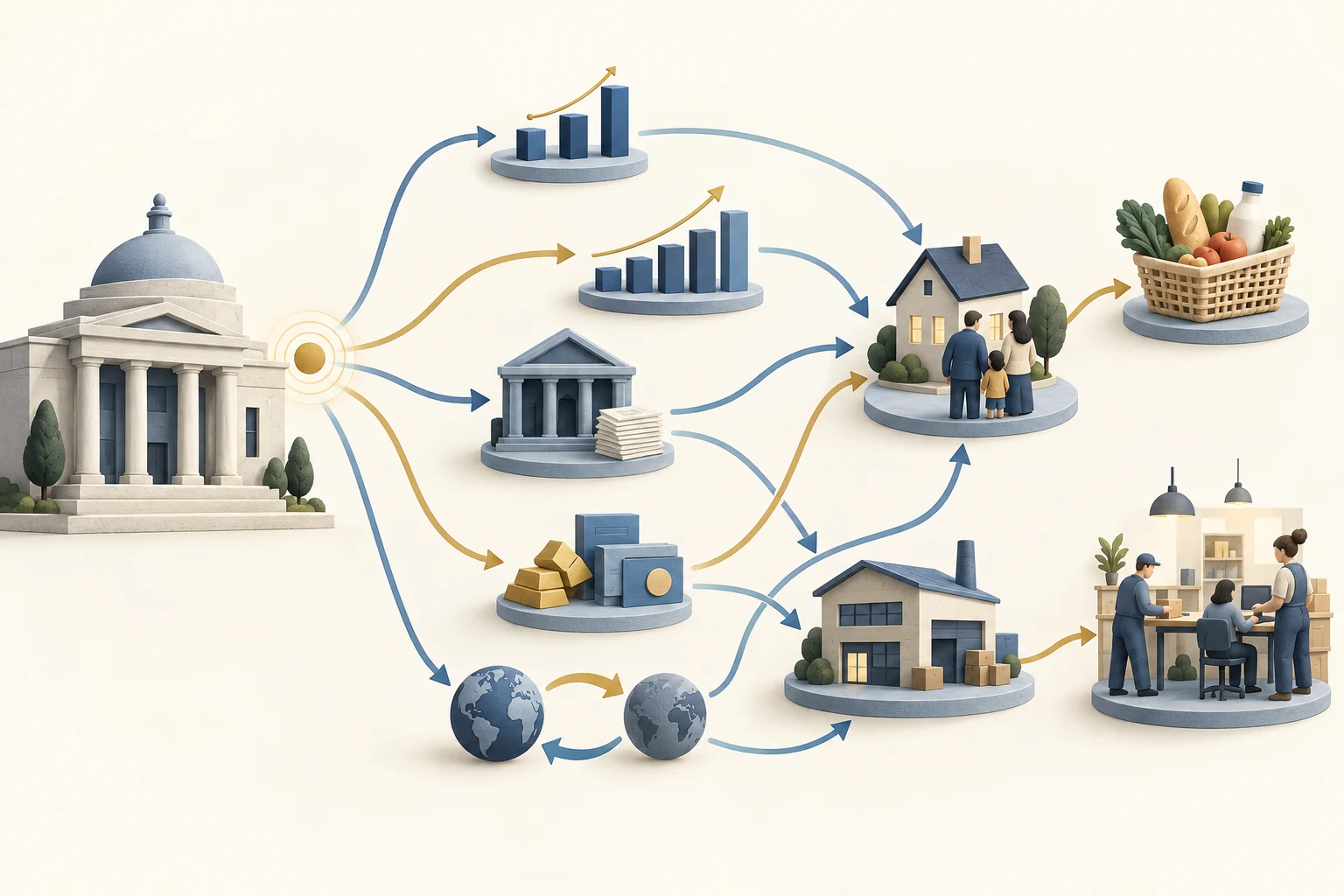
The process can be pictured as a chain: policy decisions and communication change expected financial conditions; markets and financial institutions adjust prices or the availability of credit; households and businesses reconsider saving, borrowing, spending, and investment; those choices affect total demand, employment, wages, and inflation. The chain is not strictly one-way. Financial conditions and economic outcomes feed back into expectations and later policy decisions.
The transmission mechanism is not one formula with a guaranteed output. The same policy move can have different effects depending on the starting point, what markets already expected, how contracts reset, the health of banks and borrowers, and what other economic shocks are occurring. The European Central Bank’s overview of the transmission mechanism describes channels from official rates through money markets, lending and deposit rates, expectations, asset prices, credit, spending, and prices. {source:ecbMonetaryPolicyTransmission}
From a policy decision to financial conditions
The first step is usually a change in a short-term rate that anchors or strongly influences overnight money-market rates. Those rates are used in financial markets and can inform the pricing of short-term borrowing. In the United States, for example, the Federal Reserve explains how changes in its federal funds rate affect other short-term borrowing rates and floating-rate loans. This operating example is specific to the Fed; another central bank may use a different instrument or implementation framework. {source:fedMonetaryPolicyTransmission}
Financial markets also look forward. A decision can change expectations for the future path of policy rates, which can move longer-term bond yields, currency prices, and other asset prices. If investors anticipated a decision, some adjustment may happen before the announcement. If a statement changes expectations about later decisions, longer-term rates can move even when the current policy rate does not change. The current policy rate is therefore only one input into the financing conditions faced by borrowers and investors. {source:boeMonetaryPolicyTransmission2024}
Policy does not set every interest rate directly. A bank loan rate may reflect a benchmark, the lender’s own funding cost, a borrower’s credit risk, collateral, competition, and the contract’s reset terms. A longer-term market yield may reflect expected future short rates as well as term and risk premiums. These components can move by different amounts or in different directions. The Bank of England’s explanation separates the relatively quick first stage—from Bank Rate to financial conditions—from the later effects on real activity and inflation. That is a useful framework, not a promise of a fixed timetable for every market. {source:boeMonetaryPolicyTransmission2024}
Interest rates, expectations, and the real cost of borrowing
The interest-rate channel works partly through the cost of borrowing and the reward for saving. When rates rise, new borrowing can become more expensive, and some existing variable-rate debt may reprice at a scheduled reset. A household may postpone a large purchase; a business may delay an investment whose expected return no longer covers its financing cost. When rates fall, the calculation can tilt the other way. These are incentives, not automatic responses: income, confidence, credit access, prices, and plans also matter.
Expected inflation matters because people and firms care about the purchasing power of future payments. A nominal interest rate does not by itself tell us whether borrowing is more restrictive in real terms. If the nominal rate rises while expected inflation also changes, the expected real borrowing cost may move by less or more than the nominal rate. See real versus nominal interest rates for the separate rate calculation; here the point is that inflation expectations help shape how policy is transmitted.
Communication can therefore matter alongside an implemented rate change. If a central bank is credible, its statements may influence expectations about future inflation and future rates. Firms setting prices or wages and lenders setting longer-term terms may respond to that outlook. The ECB describes expectations as a channel through which policy can affect medium- and long-term rates and price-setting, while emphasizing that the transmission mechanism has long, variable, and uncertain lags. {source:ecbMonetaryPolicyTransmission}
<!-- learn:illustration -->
The diagram maps a central-bank policy signal to several possible routes through interest rates, bank credit, asset prices, and exchange rates. Those routes connect to household and business decisions, demand, employment, and prices, and may overlap or unfold at different speeds. It is a conceptual map, not a set of measured effects or a forecast.
Banks, credit, and a worked example
Banks and other lenders help transmit policy by changing the price and availability of credit. A bank’s funding costs, balance sheet, competition, and assessment of borrower risk can affect both its rates and its willingness to lend. A tighter policy can also affect collateral values or borrowers’ ability to repay, which may lead lenders to adjust loan amounts, spreads, or standards in addition to the headline rate. Non-bank lenders and capital markets can reinforce or offset some bank responses. Research summarized by the Federal Reserve finds that bank funding costs respond differently across policy cycles; the result does not imply that every lender or borrower receives the same rate change. {source:fedMonetaryPolicyBankFundingCosts2025}
Households can be affected differently even within the same country. A borrower with a variable-rate loan may see a payment reset sooner than someone with a fixed-rate loan. A saver may receive a higher deposit rate, but the deposit rate need not rise by as much or as quickly as market rates. The ECB’s 2026 review of euro-area household transmission describes incomplete, heterogeneous pass-through and differences linked to household balance sheets, credit access, and housing-market structures. Those findings concern the euro area and should not be treated as universal country-level estimates. {source:ecbHouseholdTransmission2026}
Consider a deliberately hypothetical example in a fictional economy. A household owes 20,000 currency units on a floating-rate loan with a current annual rate of 5.00%. The central bank raises its policy rate by 1 percentage point. At the loan’s next reset, assume the lender raises this loan’s rate by 0.60 percentage points, from 5.00% to 5.60%. The 0.60-point pass-through is an invented assumption, not an estimate of a typical loan response.
For a simple one-year calculation with principal held constant, no fees, and no repayment during the year, interest would rise from 20,000 × 5.00% = 1,000 units to 20,000 × 5.60% = 1,120 units. The added annual interest is 120 units. This arithmetic isolates one cash-flow channel; an actual scheduled payment also depends on amortization, reset timing, the contract, and other charges. A fixed-rate loan would not necessarily reprice at this reset, although rates on new loans or refinancing offers could still change.
The example does not show the full effect on the household or the economy. The borrower might cut spending, use savings, or change another plan; a saver could receive different interest income; and businesses, asset markets, and exchange rates may respond at the same time. A rate change is transmitted through many balance sheets, not simply multiplied by one household’s interest bill. {source:ecbHouseholdTransmission2026}
Asset prices, wealth, and collateral
Interest-rate changes can influence the value of assets such as bonds, shares, and property. All else equal, a higher discount rate lowers the present value of a fixed stream of future cash flows. In actual markets, expected cash flows, risk premiums, supply, and investor expectations can also change, so an asset price does not have to move in one predictable direction after every policy announcement.
Asset prices can feed back into spending and credit. A household that feels wealthier may be more willing to spend; a business with more valuable collateral may find it easier to borrow. A fall in asset prices can weaken those effects or make lenders more cautious. This wealth-and-collateral route interacts with interest rates and credit supply rather than operating as a separate, perfectly measurable lever. The Federal Reserve’s policy overview describes channels through interest rates, asset prices, household and business balance sheets, and spending. {source:fedMonetaryPolicyTransmission}
Exchange rates and imported prices
In an open economy, monetary policy can also affect exchange rates. A change in relative interest-rate expectations may alter the relative attractiveness of assets denominated in different currencies, but exchange rates also respond to risk, expected growth, trade, and many other forces. A policy-rate increase therefore does not guarantee that a currency will appreciate, nor does the exchange-rate channel have the same importance in every economy.
A currency move may affect the domestic-currency cost of imported goods and inputs, and can change the price faced by foreign buyers of domestic exports. The pass-through to consumer prices depends on what is imported, how firms price goods, contracts, and the broader market setting. The ECB’s overview includes both an exchange-rate channel and possible effects on import prices. For a closer look at how trade weights and relative prices enter a currency measure, see [the real effective exchange rate guide](/learn/real-effective-exchange-rate-trade-weighted-index-explained). {source:ecbMonetaryPolicyTransmission}
From financial conditions to demand, jobs, and prices
Changes in borrowing costs, credit access, wealth, and exchange rates can affect consumption and investment. When those decisions change across many households and firms, total demand for goods and services may rise or fall relative to the economy’s ability to supply them. Firms may respond by changing production, hiring, wages, or prices. The direction and size of each step depend on the economy’s starting conditions and on other forces affecting demand and supply.
A useful simplified path is: tighter financial conditions can reduce some borrowing, spending, and investment; weaker demand can reduce pressure on firms’ capacity and prices over time. But monetary policy does not produce goods, repair supply chains, or directly reverse an energy shock. If a supply disruption raises costs while output falls, policy may affect demand and inflation persistence without immediately restoring supply. The Federal Reserve explains that its policy affects employment and inflation through financial conditions and credit costs, but that the connections are not direct or immediate and many other factors matter. {source:fedMonetaryPolicyTransmission}
Some effects can also reach prices without waiting for a long domestic-demand chain. Exchange-rate changes can alter import prices, and well-anchored or shifting inflation expectations can influence price- and wage-setting. These routes can overlap: weaker spending can affect hiring and wages, while a change in exchange rates or credit spreads can affect firms’ costs. The overall outcome is the combined response, not the sum of independent, constant multipliers. {source:ecbMonetaryPolicyTransmission}
Why the effects vary and how to read a rate decision
There is no universal delay between a policy decision and inflation, and no fixed fraction of a policy-rate change that every bank passes on. Market prices may adjust quickly when expectations change; loan and deposit rates may adjust more slowly; household budgets, investment plans, employment, and prices can respond over longer and overlapping periods. The ECB describes these lags as long, variable, and uncertain. The Bank of England also stresses the role of financial stability in whether the transmission from policy rates to financial conditions operates effectively. {source:ecbMonetaryPolicyTransmission} {source:boeMonetaryPolicyTransmission2024}
The path depends on features such as the share of variable- versus fixed-rate borrowing, household and firm debt, banks’ funding and capital, financial-market structure, competition, currency arrangements, and the source of the shock. The ECB’s household review documents differences across borrowers, savers, and country settings in the euro area; those findings help explain why a single household example cannot stand in for an economy. Do not turn a historical average or a model result into a promised response for a new policy move. {source:ecbHouseholdTransmission2026}
When evaluating a claim about a rate decision, ask what policy instrument changed and what markets had already expected; which market, loan, or deposit rate actually moved; whether the rate is nominal or adjusted for expected inflation; what contract-reset and credit terms apply; and over what horizon output, employment, or prices are being compared. Also separate a policy change from other shocks and identify whether the claim is a description, a causal estimate, or a forecast. A timeline alone does not establish that a policy move caused every subsequent change.
For adjacent topics, see how the Taylor rule frames a policy-rate decision, how the federal funds rate and prime rate differ, why deposit rates do not move one-for-one with the Fed, and why long-term Treasury yields can rise after a Fed rate cut. Those guides examine the rate-setting formula and specific U.S. rate-transmission cases in more detail.
Common questions
Q1Does a central bank directly set every borrowing rate?
No. A central bank sets or influences its policy instrument and short-term market conditions. Longer-term market rates and individual loan or deposit rates also depend on expected future rates, risk, lender funding, competition, asset prices, and contract terms.
Q2How long does monetary policy take to affect inflation?
There is no single delay that applies to every economy or policy move. Financial markets may respond quickly to new information, while loan repricing, spending decisions, hiring, and price-setting can take longer. Other shocks can change the path, so a past average is not a precise clock for a new decision.
Q3Does a rate increase always reduce inflation?
No. Tighter policy can restrain demand over time, but inflation may also reflect supply disruptions, exchange rates, expectations, and other forces. A rate change does not immediately create more supply, and the observed path alone cannot show how inflation would have evolved without the policy change.
Sources and further reading
Report an issue
We’ll prepare an email with this article link. Mark receives the report only after you send it
Quick check
Read the guide? Check yourself with 3 questions
Question 01
What does the monetary policy transmission mechanism describe?
Choose an answer to see the explanation
Options glossary
Clear definitions of essential option terms, from calls, puts, and option chains to IV, Greeks, open interest, and max pain
Browse the options glossary