

Individual Bonds vs. Bond Funds: Cash Flow, Maturity, and Risk
Compare what you own, when cash may arrive, how maturity works, and which risks and costs differ between an individual bond and a bond fund.
In this guideThe investment you own is different
Short summary
An individual bond is a debt claim on one issuer with stated payment terms and usually a maturity date. A bond fund share is an interest in a portfolio: it does not promise to return a particular bond’s face value to you on a date you choose. The difference changes cash-flow planning, diversification, pricing, and the way you assess risk. The examples below use U.S. bond and fund conventions. Products, investor protections, taxes, and trading rules differ by country. The numerical example is hypothetical and is not a forecast or a recommendation.
The investment you own is different
When you buy an individual bond, you lend money to its issuer under the bond’s indenture or other terms. The issuer may be a government, municipality, or company. The bond specifies its face value, coupon terms, maturity, and any call or other provisions. If the issuer meets its obligations and does not redeem the bond early, the scheduled principal is due at maturity. That is a contractual claim, not a guarantee that the issuer will remain able to pay.
When you buy a bond fund, you buy shares issued by the fund. The fund holds bonds and other permitted assets under a stated objective. Your share represents a proportional economic interest in the fund, not a direct claim to a particular underlying bond’s coupon or face value. A fund can receive coupon payments, sell bonds, or receive principal when holdings mature; its investors participate through the fund’s net assets and distributions after expenses. FINRA explains this distinction between an individual bond’s stated payment terms and a bond fund’s pooled holdings in its bond overview.
“Bond fund” covers more than one structure. It can mean a mutual fund, ETF, closed-end fund, or unit investment trust, and the rules for buying or redeeming shares differ. A fund may hold government bonds, corporate debt, municipal bonds, mortgage-backed securities, or a mix. Its prospectus and current holdings show what the fund is designed to own; the label alone does not tell you how broad or risky the portfolio is. Investor.gov recommends reviewing a bond fund’s prospectus and shareholder report to understand its holdings and risks.
Cash flows and maturity follow different paths
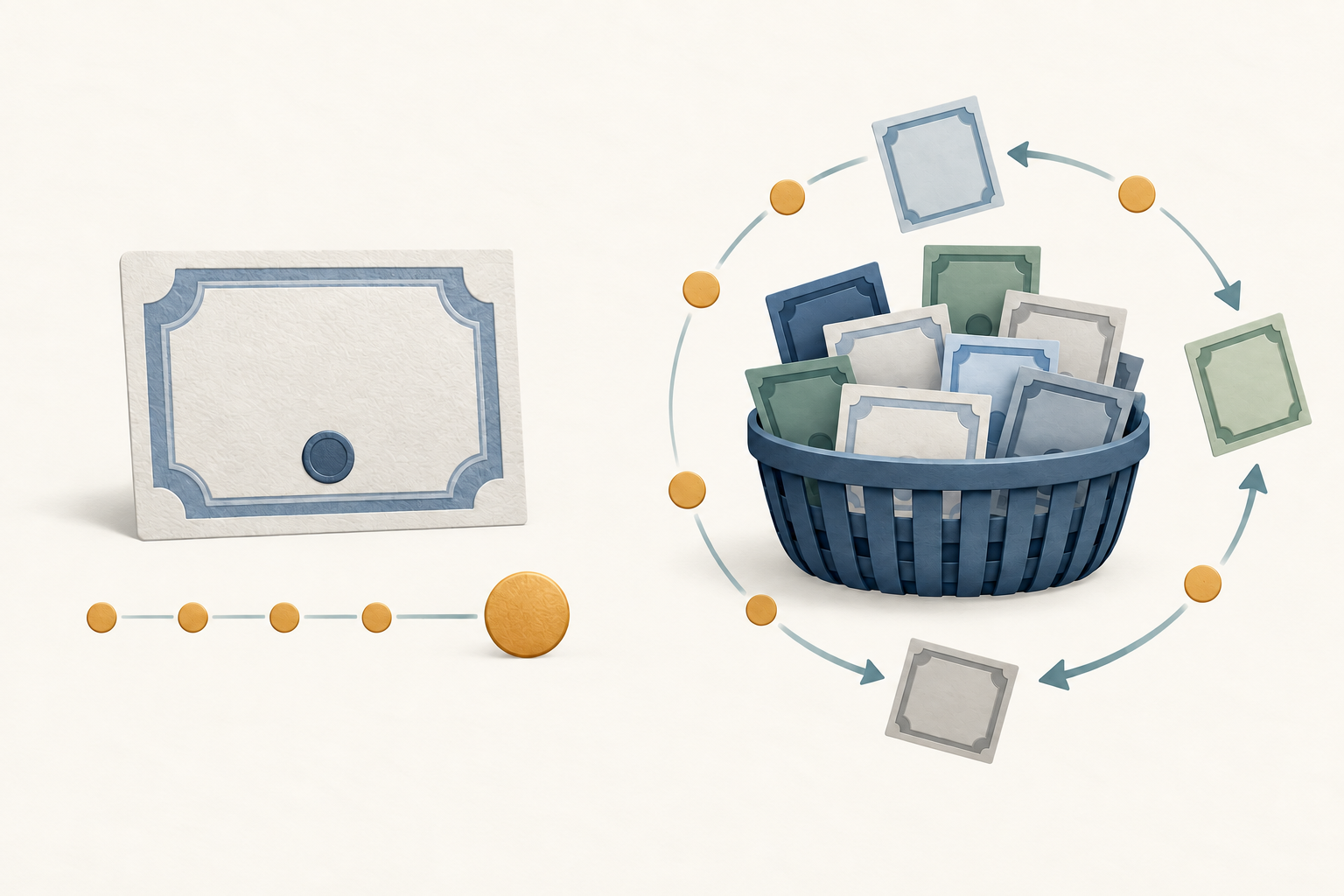
A conventional fixed-rate bond generally pays coupon interest on a schedule and is due to repay face value at maturity, subject to the issuer’s ability to pay and any call terms. A 4% coupon on $10,000 face value means $400 of stated annual coupon interest, often split into two $200 payments in U.S. corporate and Treasury examples. Coupon rate is calculated from face value; it is not the same as the yield an investor earns after considering the price paid, timing, call terms, and reinvestment.
A traditional bond fund has no single maturity date for each shareholder. Bonds inside the portfolio mature at different times, are sold, or are replaced according to the fund’s objective. The fund may distribute interest income, but the amount and timing depend on its holdings, cash flows, expenses, and distribution policy. Distributions can change, and a quoted distribution yield is not a contractual coupon or a promised total return.
There are exceptions with a planned end date. A target-maturity ETF is designed around bonds due in a stated year and may wind down around that year, but the final distribution is based on the fund’s remaining net assets and terms. It is not a promise to return your purchase price or a particular par amount. See [how bond ETFs mature and target-maturity ETFs work](/en/learn/do-bond-etfs-mature-target-maturity-etfs-explained) for that separate lifecycle.
Diversification trades off against direct selection
A bond fund can spread money across many issuers and issues, which may reduce the effect of one issuer’s trouble on the whole portfolio. The diversification depends on the mandate and actual holdings. A high-yield, single-sector, or single-country fund can still be concentrated, and many holdings can be exposed to the same economic shock. Owning a fund does not remove credit, interest-rate, liquidity, or inflation risk.
With individual bonds, you can choose the issuer, seniority, coupon structure, and maturity for each position. That can make it easier to line up stated payment dates with future cash needs. It also puts more work on the investor: assessing credit documents, call provisions, price, liquidity, and issuer concentration. Building broad diversification may require more capital or many separate bond purchases. A small collection of bonds can look varied by name while still depending on one sector or economic risk.
Trading prices and liquidity work differently
An individual bond’s market value can move before maturity. If you sell early, the price may be above or below face value; the result depends on market yields, credit conditions, liquidity, and the bond’s terms. The SEC notes that selling before maturity can produce a different amount from par and may involve a commission or broker markdown in its guide to selling bonds before maturity. Some bonds trade less often than large ETFs, so a displayed quote may not be an easy price at which a large order can execute. Ask how the broker’s quote includes markup, markdown, commission, and accrued interest.
A bond ETF trades on an exchange during the trading day. Its market price may differ from the value of its portfolio, called net asset value (NAV), and buyers and sellers pay attention to the bid-ask spread. A mutual fund generally processes purchases and redemptions at a calculated NAV once each business day, subject to the fund’s terms. FINRA describes these differences in its ETF and exchange-traded products guide and mutual fund overview.
The trading format is not a guarantee of liquidity. An ETF share can be quick to trade while some of its underlying bonds are less active, and a sudden market shock can widen spreads or change the ETF’s premium or discount. An individual bond can have a known maturity but still be costly to sell before it. For both, compare the price you can transact at and the costs of reaching it, not only the most recent displayed price.
Both can lose value for several reasons
If market yields rise, the price of an existing fixed-rate bond generally falls because its scheduled payments are less attractive than newly available bonds. A bond fund’s NAV can fall as holdings are repriced; an ETF’s exchange price can also move relative to NAV. The amount depends on duration, maturity, curve changes, credit spreads, and other holdings. [Bond ETF duration explained](/en/learn/why-bond-etfs-fall-when-interest-rates-rise-duration-explained) covers how duration estimates interest-rate sensitivity without predicting an exact return.
Credit risk applies to both choices. An individual bond concentrates exposure on one issuer and the bond’s place in its capital structure. A fund spreads or concentrates that exposure according to its portfolio. Callable bonds may be repaid early, forcing the investor or fund to reinvest at a different yield. Mortgage-backed securities can return principal sooner or later than expected. Inflation can reduce the purchasing power of fixed payments, while reinvestment risk matters when coupons or maturing principal have to be invested again.
Holding an individual bond to maturity can avoid selling it at a market price below par, but it does not erase default risk, call risk, opportunity cost, inflation, or the possibility that the investor needs cash early. A fund can offer diversification and ongoing exposure, but its share price is marked to market and it does not make a shareholder whole at a personal date. Neither format is automatically safer; compare the specific issuer or fund mandate, expected cash needs, and ability to tolerate price changes.
Compare total costs and tax treatment
Direct bond costs can include a commission or a dealer markup or markdown embedded in the transaction price. Some purchases also include accrued interest paid to the seller because the next coupon covers days before the trade. Compare the full price and expected cash flows rather than comparing the quoted coupon alone.
A fund’s costs can include operating expenses shown in its prospectus, share-class charges, transaction costs inside the portfolio, and, for ETFs, the investor’s trading spread or brokerage commission. A low expense ratio does not describe every cost, and a fund with no sales load can still have other expenses. FINRA’s mutual fund guide explains how expenses and share classes differ; use the prospectus and brokerage disclosures for the actual product.
Tax treatment depends on the investor’s country, account, and the type of bond or fund. In the United States, interest, capital gains, municipal-bond features, and fund distributions can be treated differently. A fund may distribute income or realized gains even if the investor did not sell fund shares. Do not assume a municipal fund’s entire distribution is tax-exempt. This article does not apply tax rules to readers outside the United States; check local rules and product documents.
A hypothetical $10,000 cash-flow comparison
Suppose an investor buys a five-year bond at par with $10,000 face value and a 4% annual coupon paid semiannually. One scheduled coupon is $10,000 × 0.04 ÷ 2 = $200. Across ten half-year periods, the stated coupons total $200 × 10 = $2,000. If the issuer pays as promised and does not call the bond, the investor also receives $10,000 face value at maturity.
That arithmetic describes the bond’s stated cash flows, not the investor’s full return or a guaranteed outcome. It excludes fees, taxes, inflation, the reinvestment rate on coupons, default, and early redemption. If the bond is purchased above or below par, the purchase price changes the yield and the economic result. If it is sold before maturity, the sale price may be more or less than $10,000, and transaction costs can matter.
Now compare a $10,000 investment in a bond fund. The investor owns fund shares, not a $10,000 face-value claim scheduled to mature in five years. The portfolio may distribute income, but the amount can change as holdings mature, are replaced, or are repriced and as expenses are deducted. After five years the fund shares still have a market value that can be higher or lower than the original $10,000. Reinvesting distributions buys more shares; it does not convert them into a promise to repay principal on a chosen date.
Match the structure to the question you need to answer
Start with the cash-flow question: do you need a known contractual payment date, or do you want a pooled portfolio whose income and value can change? Then compare the exposure: issuer and seniority for an individual bond; mandate, maturity profile, duration, credit mix, concentration, and expenses for a fund. For a future spending date, model what happens if you must sell early, if a bond is called, if fund distributions change, or if market prices fall.
A maturity date and a fund’s average maturity or duration are not interchangeable. A bond ladder staggers individual maturities, while a conventional bond fund usually keeps replacing holdings. The guide to [bond ladders, barbells, and bullets](/en/learn/bond-ladder-vs-barbell-vs-bullet-strategy-explained) explains how maturity timing changes across those approaches. For income measures, see [SEC yield, distribution yield, and yield to maturity](/en/learn/etf-sec-yield-vs-distribution-yield-explained); none is a substitute for reading the fund’s holdings and costs.
A useful comparison does not declare one format universally better. It shows whether the cash-flow terms, diversification, market-price exposure, fees, tax rules, and product documents fit the question at hand. Review the bond’s official offering materials or the fund’s prospectus, current holdings, and latest shareholder report before making a decision.
Common questions
Q1Does a bond fund return my original investment on a set date?
Usually no. A traditional bond fund share has no shareholder-specific maturity date or promise to return the purchase price. A target-maturity fund may plan to wind down, but its final distribution depends on remaining assets and fund terms.
Q2If I hold an individual bond to maturity, can I ignore price risk?
No. You may avoid selling at the interim market price, but the issuer could fail to pay, a callable bond could be redeemed early, and inflation or reinvestment rates can change the value of the cash flows. You may also need to sell before maturity.
Q3Are individual bonds safer than bond funds?
Not by category alone. One bond can concentrate exposure in a single issuer, while a fund can diversify or concentrate according to its mandate. Both can lose value; compare holdings, credit quality, maturity and duration, liquidity, and costs.
Sources and further reading
Report an issue
We’ll prepare an email with this article link. Mark receives the report only after you send it
Quick check
Read the guide? Check yourself with 3 questions
Question 01
What does an investor own after buying a share of a bond fund?
Choose an answer to see the explanation
Options glossary
Clear definitions of essential option terms, from calls, puts, and option chains to IV, Greeks, open interest, and max pain
Browse the options glossary