

Crypto Token Unlocks Explained: Vesting, Circulating Supply, and Dilution
Understand token unlock calendars, cliff and linear vesting, circulating supply, and why an unlock does not mean tokens were sold or predict price.
In this guideWhat a token unlock means
Short summary
A token unlock changes when some tokens may be claimed or transferred under a stated schedule. It does not automatically mint new tokens, prove that recipients sold them, or predict what the market price will do. To interpret an unlock, check the schedule, the token’s supply definition, and the rules used by the source reporting the numbers.
What a token unlock means
A token unlock is a change in transfer or claim restrictions for an allocation. A project may reserve tokens for contributors, investors, a foundation, an ecosystem fund, or another purpose, then release them over time. The schedule can be written into a vesting contract, recorded in a grant agreement, described in governance documents, or reported in a third-party calendar. Those sources do not provide identical evidence: a contract can show what its code allows, while a spreadsheet may be an estimate of planned distributions.
The word “unlock” is used loosely. It may refer to tokens becoming vested, tokens becoming claimable, a transfer restriction ending, or a distribution date. These events can happen at different times. A recipient might need to call a contract to claim vested tokens; an administrator may have to transfer a grant; or a token may already be in a wallet but subject to a separate restriction. Find the exact event and rule before treating an unlock date as a completed transfer.
An unlock is about availability under a rule, not a sale. Recipients can hold, transfer, stake, delegate, use, or sell tokens if the applicable terms and market access permit. A calendar by itself does not reveal their choice or the destination of the assets.
How cliff and linear vesting schedules work
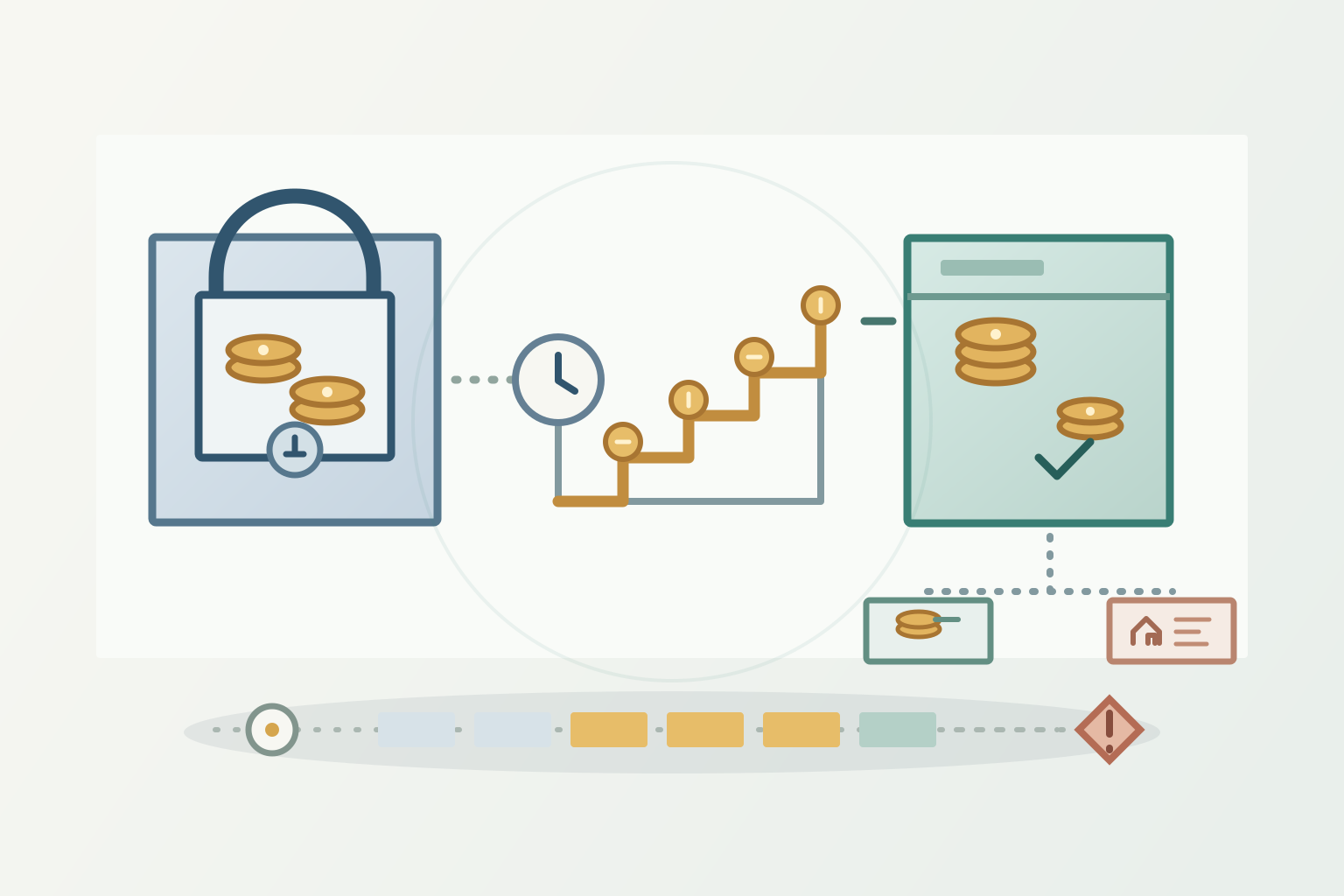
Vesting describes how an allocation becomes available over time or after stated conditions. A cliff is a period during which none, or only a specified portion, has vested. After the cliff, the remaining allocation might vest in equal steps or accrue continuously. A linear schedule spreads vesting evenly across a period; a stepped schedule releases set portions at dated intervals. Some grants instead depend on milestones, service, governance decisions, or other conditions.
For example, a hypothetical grant of 100,000 tokens could have a six-month cliff followed by 24 equal monthly releases. Under that stated rule, no amount is available during the cliff; after it ends, each scheduled installment is about 4,166.67 tokens. The exact result depends on the contract’s timestamps, rounding, claim function, and whether the schedule defines the first installment at the cliff or one interval later.
The OpenZeppelin VestingWallet reference is one implementation, not a universal standard for every token grant. Its default vesting curve is linear, and its cliff extension returns zero before the cliff timestamp. A different contract or off-chain agreement can use another curve, date convention, beneficiary, or release process. Read the actual terms instead of inferring them from a chart label such as “monthly vesting.”
Unlocking existing tokens is different from minting new ones
An unlock can move already-issued tokens out of a vesting contract or end a restriction without changing the token’s total supply. Minting creates additional units under the token contract’s rules. Emissions can mean newly minted tokens, transfers from a treasury, or distributions of an existing allocation, depending on the protocol’s terminology. Check the transaction and supply rules to see which event occurred.
The ERC-20 token interface defines totalSupply as a method that returns the token’s total supply. It does not define a standard circulatingSupply or maxSupply method, nor does the interface make every token’s supply fixed. Token contracts can include additional minting or burning logic. A transfer from a vesting contract to a beneficiary is not, by itself, proof of a mint; a mint event may instead appear as a transfer from the zero address in ERC-20 implementations.
This distinction matters when someone calls an unlock “dilution.” If a fixed amount of existing supply becomes transferable, the circulating or publicly available amount may rise while total supply stays the same. If new units are minted, total supply can rise too. Both events can change a supply ratio, but they are not the same mechanism.
Circulating, total, maximum, and committed supply
Supply labels need a definition and an “as of” date. Total supply often refers to tokens already issued, less burns, but the exact measure depends on the data source and chain. Maximum supply is a stated cap, when one exists; some tokens have no fixed cap. Circulating supply is an estimate of units considered available in the market. Unlocked supply describes tokens no longer subject to a particular restriction. Allocated or committed supply may include grants that are planned, conditional, vested, or still locked.
These labels are not interchangeable. An unlocked token held by a project treasury might still be excluded from a provider’s circulating-supply estimate. Another provider may count it if there is no known transfer restriction. For example, CoinGecko’s methodology says its token circulating-supply figure is derived from total supply less locked tokens, using information that may come from token teams. That explains CoinGecko’s own calculation; it is not a universal accounting rule.
Project reporting can also separate categories for its own purposes. The Optimism Collective’s 2026 budget update defines OP circulating supply using tokens in general circulation with no known transfer restrictions, and reports committed tokens separately. It says its circulating-supply definition may differ from other parties’ definitions. Its Year 5 figures are directional estimates subject to performance and governance input. The OP Token Overview and earlier supply clarification also show why allocation charts and projected release schedules should be checked for dates, assumptions, and governance decisions.
Calculate an unlock against more than one denominator
Suppose a hypothetical token has a maximum supply of 1,000,000 units, a reported circulating supply of 250,000 units, and an announced unlock of 50,000 units. The unlock is 5% of maximum supply:
50,000 ÷ 1,000,000 = 5%
It is also 20% of the reported circulating supply before the event:
50,000 ÷ 250,000 = 20%
Both calculations are correct, but they answer different questions. The first compares the unlock with the maximum-supply denominator; the second compares it with the current circulating estimate. Neither says that the 50,000 units will be sold. If the reporting provider counted all 50,000 units as circulating after release and nothing else changed, its estimate would rise to 300,000. If the recipient still controls the tokens or the provider excludes that wallet, the reported figure could differ.
Valuation ratios inherit these assumptions. At a hypothetical price of $2, 250,000 circulating units imply a market capitalization of $500,000 under that supply definition. Multiplying $2 by the 1,000,000 maximum gives a fully diluted valuation of $2,000,000. This arithmetic holds the price constant across units that may not yet exist or be freely transferable. It is a comparison convention, not a forecast of future price or value.
What people mean by dilution
“Dilution” can refer to more than one change. If a protocol mints new units, an existing holder’s fraction of total supply can fall if that holder receives none of the new units. If already-issued tokens move from a locked allocation into circulation, total supply may be unchanged while the publicly available denominator grows. A holder’s share of that circulating amount can fall even though the holder still owns the same number of tokens.
For example, 10,000 tokens are 4% of a 250,000-token circulating figure. If the figure later includes 50,000 unlocked tokens, those same 10,000 are about 3.33% of the new 300,000-token figure. This change in the fraction of the reported float does not mean the wallet lost 1,667 tokens, and it does not describe the holder’s share of total supply unless that denominator is explicitly used.
Governance power may use yet another denominator: eligible votes, delegated voting weight, a snapshot balance, or a contract-specific rule. A token unlock can therefore affect transferability, circulating-supply estimates, and voting calculations differently. Read the relevant rules rather than using “dilution” as if it named one automatic outcome.
How to review an unlock calendar
Start with the project’s own token contract, allocation documents, governance decisions, and grant terms. Record the source date and whether the schedule is binding, approximate, or conditional. If the schedule is on-chain, check the vesting contract, beneficiary, start time, cliff, duration, release cadence, and claim or transfer restrictions. If it is an estimate, identify which organization can change the timing and what approvals or milestones apply.
Then compare scheduled amounts with current supply data on the same date. Confirm the token and chain, decimals, bridge or wrapped-token treatment, burns, new issuance, and which wallets the data provider excludes from circulation. A calendar can omit revised grants, delayed claims, treasury transfers, tokens already vested but unclaimed, or allocations distributed through multiple addresses. One timestamped chart is not a complete audit of every token holder.
Check whether an announced date refers to vesting, claim eligibility, a transfer, or a provider’s expected circulating-supply update. Review the actual transaction or latest issuer report after the date. A schedule can change through governance or a new grant decision, and an estimate can be revised when the provider receives better wallet information. Optimism’s supply clarification is one example of an issuer explaining that projected distribution charts were illustrative rather than exact.
Why an unlock is not a price prediction
More tokens becoming transferable can matter to market supply, but the price effect depends on what recipients do and what buyers expect. Some recipients may keep tokens, stake them, use them in a protocol, or transfer them to a treasury. Others may sell over time or hedge exposure before an unlock. Market participants may already know the schedule and have incorporated expectations into prices. Liquidity, demand, market conditions, and other events can matter at the same time.
For those reasons, an unlock calendar is a prompt to check allocation, timing, restrictions, and reporting methodology—not a standalone buy or sell signal. It does not tell you how many tokens will reach an exchange, how much will be sold, or how the market will respond. This guide explains supply mechanics and calculation limits; it does not value a token or recommend a trade.
Vesting restrictions are also different from staking lockups and token approvals. For those separate mechanics, see the guides to Ethereum staking and liquid staking and token approvals and allowances.
Common questions
Q1Does a token unlock mean the project minted new tokens?
Not necessarily. A vesting contract can release units that were already included in total supply. Check the contract and transaction history to distinguish a transfer or restriction change from new issuance.
Q2Are unlocked tokens part of circulating supply?
Not always. Each project or data provider can use a different definition. An unlocked treasury or team balance may still be excluded from a particular circulating-supply estimate.
Q3Do token unlocks usually make prices fall?
There is no automatic result. An unlock shows that tokens may become available under stated terms; it does not show whether recipients will sell or whether market participants already expected the event.
Sources and further reading
Report an issue
We’ll prepare an email with this article link. Mark receives the report only after you send it
Quick check
Read the guide? Check yourself with 3 questions
Question 01
What does an unlock by itself establish?
Choose an answer to see the explanation
Options glossary
A call or put whose strike is near the underlying price; it has little intrinsic value and often substantial sensitivity to time and volatility.
Read the deeper guideCall optionA contract that gives its holder the right, but not the obligation, to buy the underlying at the strike before or at expiration under the contract terms.
Read the deeper guidePut optionA contract that gives its holder the right, but not the obligation, to sell the underlying at the strike before or at expiration under the contract terms.
Read the deeper guide