

Crypto Staking vs DeFi Lending: How the Yields and Risks Differ
Compare proof-of-stake rewards with DeFi lending interest, see how supply rates and withdrawals work, and understand what an advertised crypto yield leaves out.
In this guideThe same percentage can describe a different job
Short summary
Staking and crypto lending can both display a yield, but the payment comes from different activity. Proof-of-stake staking helps a network reach consensus; a DeFi supplier puts tokens into a lending market that borrowers use. A percentage alone does not tell you what claim you receive, how the rate changes, or how quickly you can exit.
The same percentage can describe a different job
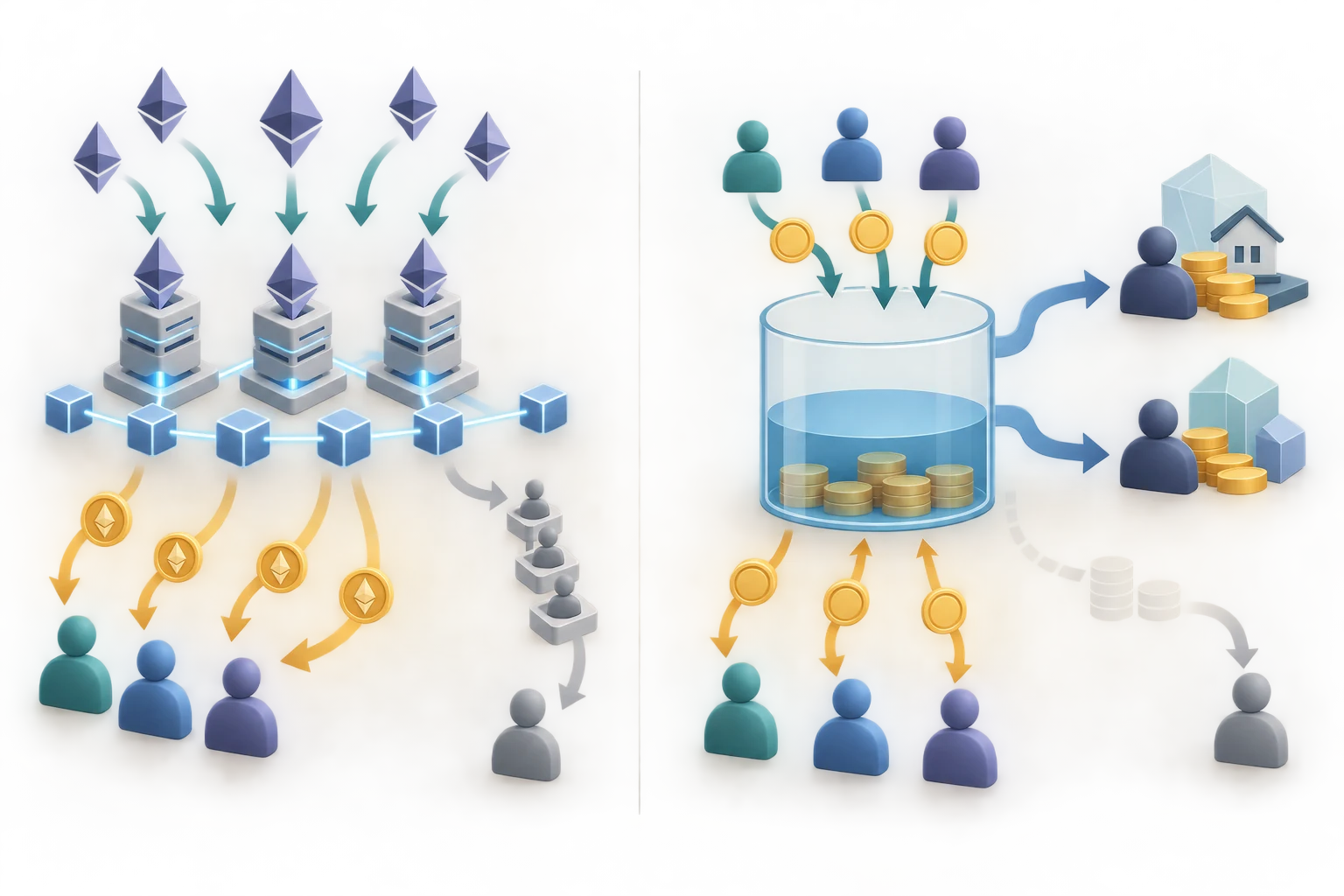
In proof-of-stake staking, a validator commits eligible tokens to help a network check and order transactions. In crypto lending, a supplier makes assets available to borrowers under a protocol or service’s rules. A staker participates in network security, directly or through an operator; a lender provides capital. Those are different cash flows, even when a dashboard puts both under “earn.” A DeFi lending pool generally combines supplied assets so borrowers can draw from available liquidity. The supplier does not usually make a separate loan to one named person. The protocol tracks a claim on the pool, applies its interest model, and can impose withdrawal constraints. By contrast, a staking position is exposed to validator operations, protocol rewards and penalties, and the path used to withdraw or redeem stake. Sources: Ethereum.org staking overview, proof-of-stake rewards and penalties, and pooled staking.
What proof-of-stake rewards pay for
On Ethereum, validators deposit ETH and perform duties such as attesting to blocks and sometimes proposing them. The protocol rewards valid participation; a missed duty can mean a reward is not earned, while specific slashable behavior can destroy part of a validator’s stake. Rewards depend on protocol rules and network participation, not on an individual borrower paying interest. Running a validator yourself, delegating through a service, and joining a pool are not identical positions. A service may deduct a fee, and a pool adds operator and contract dependencies. A liquid staking token is another asset whose contract and market price can differ from a direct ETH balance or its redemption reference. The Ethereum.org staking overview, rewards and penalties guide, and pooled staking guide describe these distinctions. For Aave V3 as one example, see Aave: Introduction to Aave V3.
How a DeFi supplier earns interest
A DeFi supplier transfers an asset to a smart-contract market. Borrowers draw from the market and pay interest according to the market’s current rate model. In a simplified utilization model, utilization is the share of supplied liquidity that is borrowed. More borrowing relative to available supply can push the supply rate higher; when demand falls, the rate can fall too. Governance parameters, protocol reserves, incentives, and market design affect the result. Aave V3 is one example, not a universal template: suppliers receive aTokens, the supply rate varies with utilization, and interest accrues to the position. The receipt token represents a protocol-defined claim; it is not a bank balance or a guarantee that every amount is immediately withdrawable. Other markets can use different receipts, rate curves, fee splits, and withdrawal rules. See Aave’s introduction to V3.
Why APR and APY do not make the positions comparable
APR is an annualized rate without a compounding promise; APY represents compounding under stated assumptions. A quoted rate can also be a current variable rate, a promotional rate, or a reward paid in a different token. Compare the same measurement period and compounding convention, then account for operator or protocol fees, network costs, withdrawal charges, and incentives that may end or change. The unit of the reward matters. Staking ETH can increase the number of ETH while ETH’s market price falls. A lending position denominated in a stablecoin can accrue more units while that token trades below its target. If the interface reports dollar value, it adds a market-price assumption on top of the protocol’s token-denominated accounting. Token balance growth and purchasing-power return are not the same measure.
A hypothetical 90-day comparison
Assume, purely to show the arithmetic, a constant 4% simple annual rate for 90 days, no fees, no compounding, and no losses. The formula is principal × rate × days ÷ 365. A supply of 10,000 USDC would accrue about 98.63 USDC, leaving 10,098.63 USDC if the rate stayed constant. That dollar value also assumes USDC remains worth exactly one dollar; the example is not a rate quote or a claim about a live market. Now suppose 5 ETH is worth $2,000 per ETH at the start, also $10,000 in starting value. At the same illustrative rate and period, it accrues about 0.049315 ETH. If ETH then trades at $1,800, the 5.049315 ETH position is worth about $9,088.77. A positive token-denominated reward can coexist with a negative dollar return because the asset price moved. The example assumes perfect validator performance and excludes pool fees, slashing, taxes, gas, liquidity discounts, and any rate change. See Ethereum.org: Staking withdrawals and Aave: Withdraw tokens for two protocol-specific paths.
Withdrawal paths have different bottlenecks
Ethereum validator exits are rate-limited and can take variable time; once an account is eligible and has withdrawal credentials, the protocol processes withdrawals through its sweep mechanism. A staking pool or liquid staking token adds the provider’s redemption process or a market sale, each with its own queue, liquidity, and price conditions. Those routes are not interchangeable. See Ethereum.org’s withdrawal guide and its provider-specific notes. A lending supplier can generally withdraw only what the market can return under its rules. In Aave, for example, withdrawal depends on available unborrowed liquidity, and a supplied asset used as collateral may be constrained while a borrow is open. High utilization can coincide with a high displayed rate and less immediately available liquidity. The Aave withdrawal guide explains those conditions; a quoted rate is not an exit guarantee. The dated, U.S.-focused Investor.gov bulletin on crypto interest-bearing accounts describes those product risks; it is not a current rule or a global statement about every provider.
A centralized “Earn” account is a separate contract
An exchange or custodian may market an interest-bearing crypto account, but the label alone does not reveal what happens to the assets. The provider may lend or otherwise deploy them, and the customer’s rights depend on the specific agreement, provider, product, and jurisdiction. This is not automatically proof-of-stake staking or a DeFi pool position. A February 2022 U.S. Investor.gov bulletin described risks of crypto interest-bearing accounts, including lending activity, provider failure, illiquidity, and the absence of the same protections as bank deposits for the products it discussed. The bulletin is dated investor education, not a current rule or a global legal conclusion about every product. Read current product terms and local rules rather than inferring legal protection from an “earn” label.
Risks that a percentage leaves out
Staking risk can include validator downtime and missed rewards, slashable behavior, operator or custody failures, pooled-contract risk, delayed exits, and a liquid staking token trading below a redemption reference. DeFi lending risk can include smart-contract defects, oracle or governance changes, impaired collateral, borrower losses, low withdrawal liquidity, and chain or interface failures. Which risks apply depends on the chain, asset, contract, operator, and position design. Both routes also carry asset-price and access risk. A stablecoin can lose its target; ETH can fall in dollar terms; a wallet problem or congested network can delay an intended transaction. A third-party interface may add its own approvals or operational dependencies. None of those outcomes is captured by a single annualized percentage, and diversification across protocols does not remove common exposures such as the same token, chain, or custodian.
Compare the claim, not only the rate
Before comparing two offers, write down the exact asset and network, where the yield originates, whether it is paid in the same asset, and whether the rate is gross or net. Check the time basis, compounding assumption, variable-rate rules, service fees, token incentives, and any lock or exit process. For a lending pool, ask what receipt token you hold and what liquidity is available; for staking, identify who runs the validator, who controls the keys, and how stake is withdrawn. Then separate nominal token growth from value in your own spending currency. Test what happens if the token price falls, a stablecoin depegs, the lending rate drops, the pool is highly utilized, or an exit queue lengthens. These are comparison scenarios, not forecasts. For the mechanisms behind each side, continue with the Ethereum staking guide, DeFi lending collateral guide, stablecoin depeg guide, and wallet recovery guide.
Continue with related guides
These explain the mechanics behind staking, lending, stablecoin value, and wallet control:
Common questions
Q1Is staking the same as lending crypto?
No. Proof-of-stake staking supports validator duties and network consensus. Lending supplies assets for borrowers under a protocol or provider’s rules.
Q2Does a higher DeFi supply APY stay fixed?
Not unless the exact product terms guarantee it. In variable-rate markets, utilization and protocol parameters can change the supply rate.
Q3Can a DeFi supplier always withdraw immediately?
Not necessarily. Withdrawal can depend on unborrowed pool liquidity, collateral use, network execution, and protocol-specific rules.
Q4Is a crypto “Earn” account covered like a bank deposit?
Do not infer that from the label. Product rights and protections vary by provider and jurisdiction; review current terms and local rules.
Sources and further reading
Report an issue
We’ll prepare an email with this article link. Mark receives the report only after you send it
Quick check
Read the guide? Check yourself with 3 questions
Question 01
What does proof-of-stake staking primarily support?
Choose an answer to see the explanation