

Repo vs. Reverse Repo: Collateral, Funding, and Rate Differences
Understand repo and reverse repo, calculate repurchase interest, compare collateral motives, and distinguish US SOFR from global repo markets.
In this guideA repo has a cash leg and a securities leg
Short summary
A repo is a two-leg transaction in which a security is transferred for cash and the parties agree to reverse the exchange later at an agreed price. The cash-raising security seller commonly calls it a repo; the cash provider may call the same trade a reverse repo. A specific bond can also be valuable as collateral in its own right, so its repo rate may differ from a general-collateral rate.
A repo has a cash leg and a securities leg
In a repurchase agreement, one party transfers securities and receives cash, then agrees to repurchase the securities later for an agreed amount. The other party provides cash and receives the securities during the term. The two exchanges are negotiated together: the initial cash amount, security or collateral basket, maturity, repurchase price, and settlement terms all shape the transaction.
The cash-raising party may use the proceeds to finance a bond inventory, meet a short-term cash need, or support another position. The cash provider may want a secured place to invest cash. Another participant may care more about obtaining a particular bond than earning the highest cash return. Repo markets therefore move both funding and securities through the financial system. The BIS describes repo as important to the flow of cash and securities, while the ECB discusses how repo liquidity can also support bond-market liquidity and swap-market activity.
A repo is economically similar to short-term borrowing backed by securities, but that does not make every repo legally identical to a loan. The legal treatment, rights to use or substitute collateral, close-out process, and settlement protections depend on the agreement and applicable jurisdiction. It is safer to describe the cash flows and contract terms than to assume one legal form applies worldwide. See the BIS review of repo market functioning and the ECB discussion of repo and bond-market liquidity.
Repo and reverse repo depend on whose perspective you use
In common market usage, the party that sells a security to raise cash and agrees to buy it back describes its side as a repo. The counterparty that pays cash and receives the security may describe its side as a reverse repo. These labels can seem contradictory because they name the same pair of cash and securities transfers from opposite sides.
A central bank may name an operation from its own point of view. The New York Fed says its Desk's repo operation is a purchase of securities from a counterparty with an agreement to resell later. Its reverse repo operation is a sale to a counterparty with an agreement to repurchase later. The counterparty is on the opposite side of each transfer. That is why a sentence such as “repo rates rose” is incomplete unless it identifies the market, collateral, tenor, and rate convention.
When comparing two descriptions, write down who pays cash first and who transfers the securities first. Then identify who must return cash and who must return securities at maturity. This simple direction check prevents a repo label from being mistaken for a different security, a different interest-rate benchmark, or an outright bond sale with no agreed second leg. The New York Fed's repo and reverse repo overview explains the Desk's own naming convention.
Calculate the agreed repurchase amount
The cash borrower normally repays more than the amount initially received. In a simplified transaction with no interim coupon cash flow, the cash interest can be represented as:
Cash interest = cash principal × annual repo rate × accrual days ÷ day-count denominator
Suppose a hypothetical party receives $100,000,000 for one accrual day at a simple annual repo rate of 3.60%, using ACT/360 for this illustration. The interest is $100,000,000 × 0.036 × 1 ÷ 360 = $10,000. The hypothetical repurchase amount is therefore $100,010,000: the original $100,000,000 cash plus $10,000 of repo interest.
The example is arithmetic, not a live rate or a quote for any security. It assumes one accrual day, a constant simple rate, no coupon or manufactured payment during the term, and no fees or other adjustments. Actual agreements specify value dates, maturity dates, rate conventions, and cash-flow treatment. A Friday-to-Monday period may accrue more than one calendar day under a contract's convention; “overnight” describes the market tenor, not permission to ignore dates.
The $10,000 is the cash-leg financing amount in this simplified example. It does not by itself measure the cash provider's net investment return after operational costs, balance-sheet costs, collateral risk, and any other transaction terms. Nor does it tell the securities seller whether the financed bond position made or lost money overall. The repo price calculation answers one narrower question: how much cash is due at repurchase under the stated assumptions?
A haircut is a buffer, not a guarantee
A cash lender may receive collateral worth more than the cash advanced. In a separate hypothetical illustration, a party posts securities with a market value of $102,000,000 to receive $100,000,000. The $2,000,000 difference is a cushion against price movements and liquidation costs, subject to the contract's valuation and margin terms.
The percentage called a haircut depends on its denominator. If measured as the difference divided by collateral value, the illustration gives ($102,000,000 − $100,000,000) ÷ $102,000,000 = about 1.96%. If someone instead reports collateral value above cash as a percentage of cash, the same figures give 2.00%. Those are two ways to describe the same cushion, not two separate amounts. Always check the contract or dataset's definition before comparing haircut numbers.
A cushion can be depleted if collateral prices fall, the security becomes hard to sell, or a counterparty fails before exposure is covered. Margin calls can require additional collateral or cash, but their timing, thresholds, eligible assets, and dispute process depend on the agreement. A repo still has counterparty, market, liquidity, operational, legal, and settlement risks. The BIS notes that haircuts vary with trading motive, maturity, and collateral characteristics; its 2025 analysis is evidence about studied transactions, not a universal haircut schedule. See BIS research on repo haircuts.
General collateral is different from a specific bond
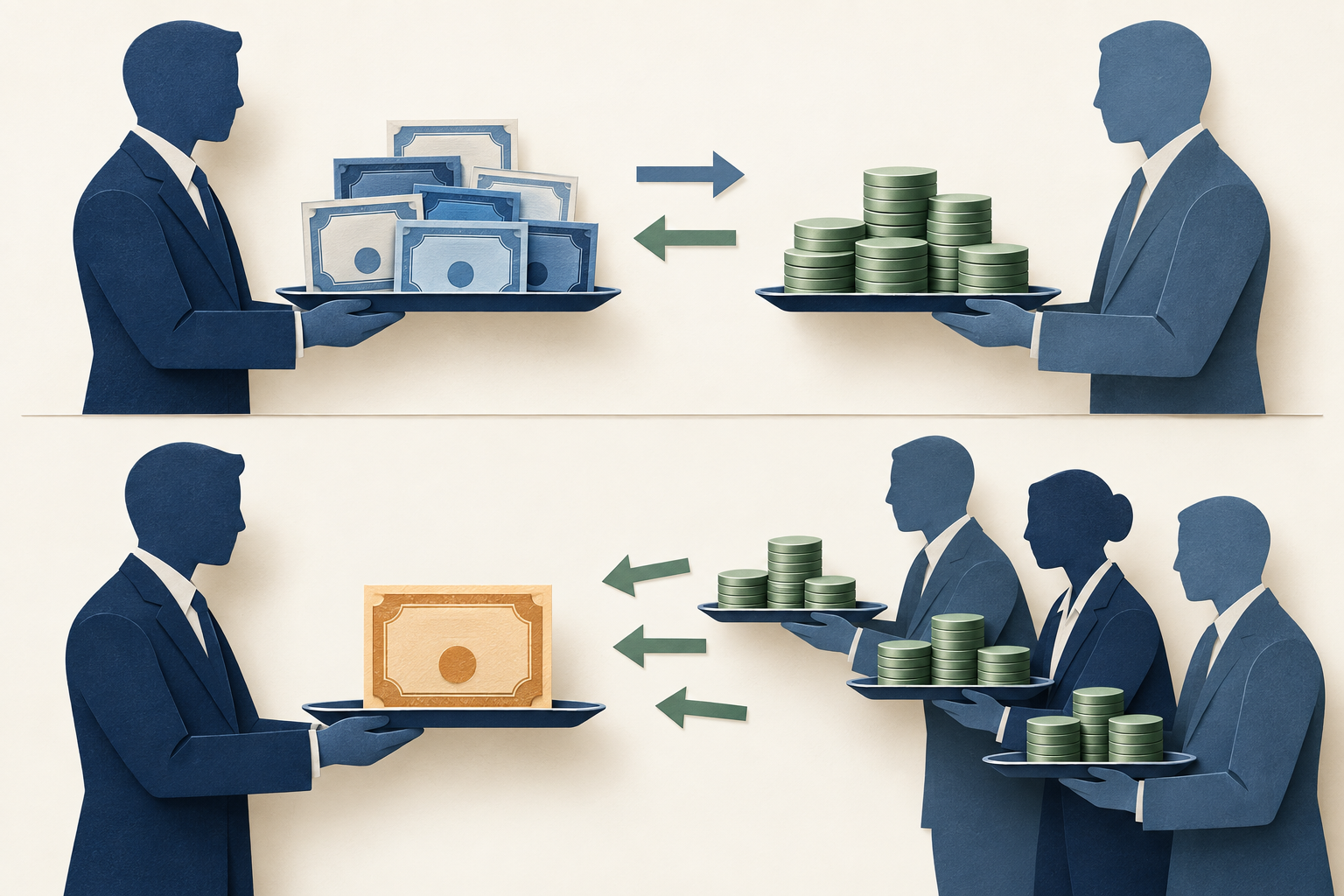
In a general-collateral, or GC, trade, the cash provider accepts any security from a defined eligible basket. The exact basket and substitution rights depend on the market and contract. The parties primarily need a financing transaction against acceptable collateral, rather than one named issue.
In a specific-collateral trade, the agreement identifies the security, often by its issue identifier, at the time the trade is arranged. The cash provider may need that bond to complete a delivery, support market making, or meet another securities obligation. “Specific collateral” and “special” do not mean the same thing. A specific-security trade is special when its repo rate is notably below the comparable GC rate, reflecting a price paid through the cash return to obtain that particular security.
The ECB's euro money-market reporting distinguishes general collateral from trades against identified securities and explains that specialness refers to a specific-security repo trading below the GC rate. The exact categories and reporting coverage vary among datasets. The New York Fed also notes that its US SOFR calculation includes a filtered portion of centrally cleared DVP activity that can contain special-collateral trades, so SOFR should not be described as a pure GC-only rate. See the ECB's 2022 Euro money market study and the New York Fed's SOFR description.
Cash demand and securities demand can pull rates apart
A GC repo rate is often read as a price for short-term cash financing against a basket of acceptable bonds. A specific bond can trade at a different rate because one side wants that security itself. If a cash provider strongly wants a scarce issue, it may accept a lower return on its cash to receive the bond. The repo rate on that security can then sit below the GC rate even though both trades have the same currency and similar maturity.
That lower rate does not by itself show that the cash borrower is a weaker credit. It can reflect the bond's scarcity or usefulness to the cash provider. Conversely, a higher general-collateral rate may reflect cash demand, supply of lendable cash, market balance-sheet capacity, tenor, or other terms. Both financing conditions and collateral availability matter; a single observed rate cannot identify which factor dominated.
ECB analysis of the euro repo market has documented episodes in which scarce specific government bonds traded at lower repo rates than general collateral, and its 2022 report describes security supply and demand as important drivers in that sample. The findings are tied to the euro-market periods examined there, not a claim about today's rate spread or every jurisdiction. The BIS likewise emphasizes that repo markets differ across jurisdictions and can be affected by market structure and balance-sheet constraints. See the ECB's dated market study and the BIS Committee on the Global Financial System report.
SOFR and Federal Reserve facilities are US-specific examples
SOFR is a US dollar reference rate administered by the Federal Reserve Bank of New York. The New York Fed describes it as a broad measure of the cost of borrowing cash overnight collateralized by Treasury securities. It is calculated from transaction data across specified US Treasury repo market segments, not from one negotiated repo and not from every repo market worldwide. Its published methodology describes a volume-weighted median and details how the included segments and certain special transactions are handled.
A quoted bilateral repo rate can differ from SOFR because the collateral, counterparty, tenor, clearing arrangement, trade time, and funding or securities motive differ. SOFR can help describe a broad US overnight financing market, but it is not a universal repo quote, a policy rate, or necessarily the rate a particular borrower can transact at. The New York Fed may update reference-rate methodology, so readers should consult the current SOFR page and methodology information before using a specific fixing or historical series.
The Federal Reserve's repo facilities are another US-specific example and use the Desk's perspective. The New York Fed describes repo operations as securities purchases by the Desk that temporarily increase reserve balances, and reverse repo operations as securities sales that temporarily reduce them. It describes Standing Repo operations as limiting upward pressure on money-market rates and Overnight Reverse Repo operations as limiting downward pressure. The policy settings, eligible counterparties and collateral, operation rates, and operating details can change; check the current New York Fed materials rather than treating a past setting as current. These facilities do not define how every private repo market names or prices its trades.
Read a repo quote by naming the trade first
Before interpreting a repo rate, identify the currency, cash amount, security or collateral basket, maturity, value dates, day-count convention, and which party's quote you are reading. Confirm whether the trade is GC or tied to a named issue, whether it is cleared or bilateral, and how collateral is valued, substituted, and margined. Without those details, two rates with the same label may answer different questions.
Then separate a transaction rate from a benchmark and from a central-bank facility rate. A daily SOFR fixing is an aggregate reference observation with a stated methodology. A repo quote for one CUSIP is a negotiated trade reflecting both cash and collateral conditions. A Federal Reserve operation rate is a policy implementation term for an eligible US operation. These measures are related, but they are not interchangeable.
Finally, describe what the evidence says before assigning a cause. “This issue's repo rate was below the same-date GC rate” states a comparison. “The borrower was distressed” adds a conclusion that the rate alone does not establish. The most useful interpretation keeps the cash-flow direction, collateral identity, tenor, market, and observation date visible.
For a related comparison, the Treasury futures implied repo guide explains a cash-bond-versus-futures-delivery calculation, not an actual repo quote. The Treasury futures delivery options guide covers another contract feature that affects delivery economics.
Common questions
Q1Is a repo legally just a loan?
Not necessarily. A repo is commonly documented as a securities sale with an agreed repurchase, and it is economically similar to secured borrowing. Legal treatment and rights depend on the contract and jurisdiction.
Q2Does a lower special repo rate mean the borrower is riskier?
Not by itself. The rate may be lower because the cash provider values access to a particular security and accepts a lower cash return to obtain it. Other trade terms still matter.
Q3Is SOFR the same as the repo rate I can transact at?
No. SOFR is a broad US overnight Treasury-collateralized reference rate calculated from specified transaction segments. A particular trade can differ by collateral, counterparty, tenor, timing, and other terms.
Sources and further reading
Report an issue
We’ll prepare an email with this article link. Mark receives the report only after you send it
Quick check
Read the guide? Check yourself with 3 questions
Question 01
In a simplified one-day ACT/360 repo, how much interest accrues on $100,000,000 at a hypothetical 3.60% annual rate?
Choose an answer to see the explanation
Options glossary
A call or put whose strike is near the underlying price; it has little intrinsic value and often substantial sensitivity to time and volatility.
Read the deeper guideCall optionA contract that gives its holder the right, but not the obligation, to buy the underlying at the strike before or at expiration under the contract terms.
Read the deeper guidePut optionA contract that gives its holder the right, but not the obligation, to sell the underlying at the strike before or at expiration under the contract terms.
Read the deeper guide