

Why CPI Inflation Rates Change After Release: Seasonal Factors and C-CPI-U Revisions
Learn why some U.S. CPI history changes after release, how annual seasonal-factor updates differ from C-CPI-U revisions, and which series to compare.
In this guideFirst identify which index and version changed
Short summary
Reopening a U.S. CPI chart can show different history for more than one reason. BLS recalculates seasonal factors each year, which can revise past seasonally adjusted CPI values. The not-seasonally-adjusted CPI-U and CPI-W are normally final when first published, while the separate C-CPI-U index has preliminary values that receive three interim revisions as spending data arrive.
First identify which index and version changed
“The CPI changed” can refer to several different things. The U.S. Bureau of Labor Statistics (BLS) publishes the CPI-U and CPI-W, and it also publishes the chained CPI-U, usually written C-CPI-U. Many series are available both seasonally adjusted and not seasonally adjusted. A chart might show an index level, a one-month percent change, or a 12-month change. Those are not interchangeable.
There are also two different clocks: the month prices refer to and the date a value was released or later downloaded. For example, “February CPI” refers to prices collected for February, even though its first release comes later. A file downloaded today may contain updated seasonal history or a later C-CPI-U estimate that was not in the original release.
Before comparing two charts, write down the population and geography, item group, index, seasonal-adjustment status, measure (level or rate of change), reference month, and download or release date. The BLS [CPI FAQ]({source:blsCpiFaq}) distinguishes CPI-U, CPI-W, and C-CPI-U and explains their publication and revision practices. Without those details, two charts can look inconsistent even when each accurately displays a different series or vintage.
Why seasonal adjustment can change past values
Prices often move in recurring patterns. Apparel prices may fall during predictable sale periods; energy use and prices can follow weather-related patterns; travel and some services can have calendar-related movements. Seasonal adjustment estimates and removes regular within-year patterns so users can more easily compare nearby months. It does not change the prices households actually paid.
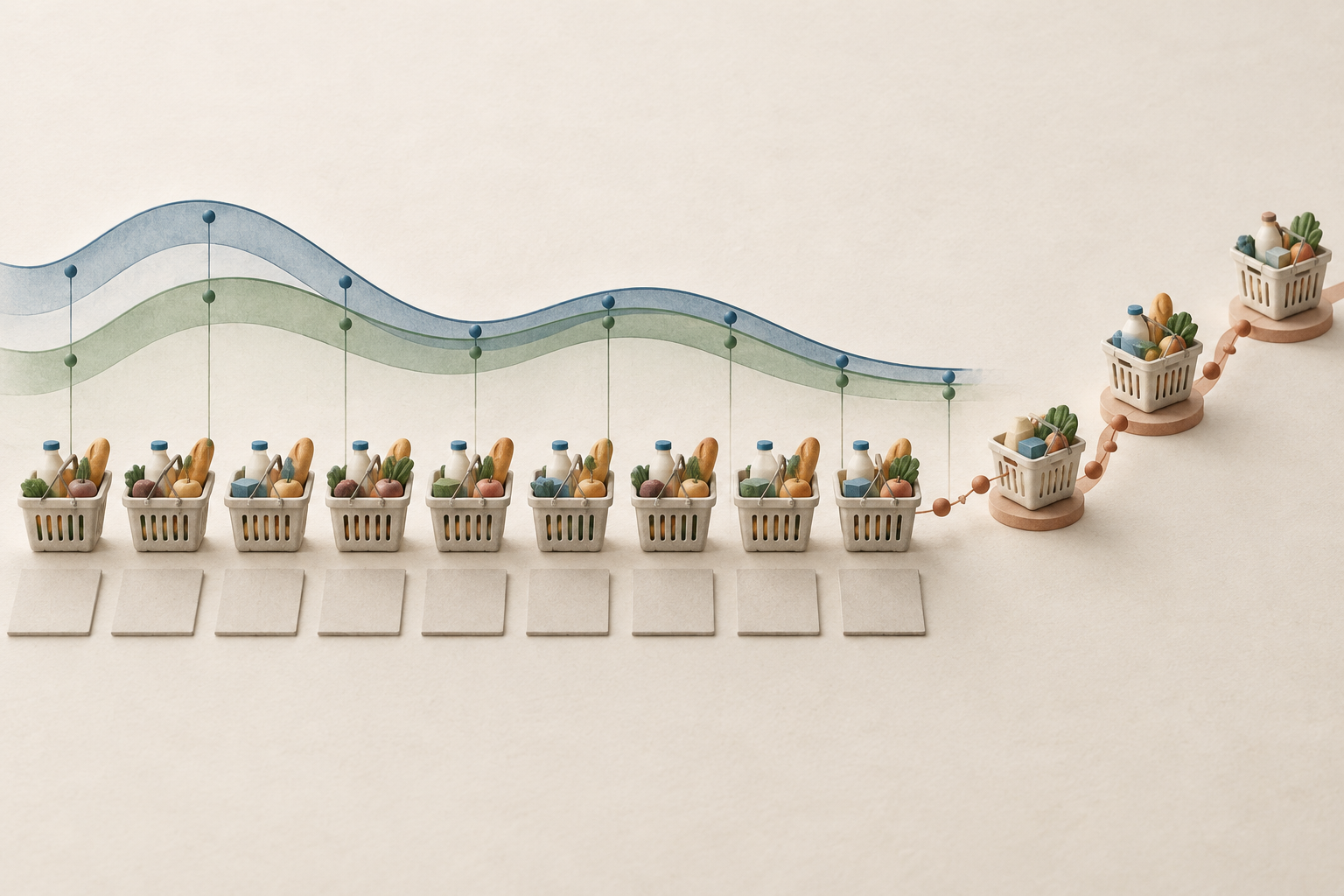
The seasonal pattern is estimated from data, and the estimate can improve when another year of observations becomes available. BLS therefore recalculates CPI seasonal factors each year after the January CPI release. The newly estimated factors are applied to eligible past observations as well as current ones. The [BLS seasonal-adjustment page]({source:blsCpiSeasonalAdjustment}) says the annual process can revise up to five years of seasonally adjusted CPI history; older seasonally adjusted indexes are treated as final.
That is a re-estimation of the adjustment layer, not a late correction to every price quote. The underlying not-seasonally-adjusted CPI series is not changed by this annual factor update. A revised seasonally adjusted month-to-month rate can therefore coexist with an unchanged NSA index for the same month.
A worked example: the same NSA data, a different monthly rate
Suppose an illustrative CPI-U series has January and February seasonally adjusted index levels of 317.0 and 318.5 in an earlier download. The month-to-month change is:
(318.5 ÷ 317.0 − 1) × 100 = 0.47%, or about 0.5%
After a later annual seasonal-factor recalculation, imagine that the same months appear as 317.2 and 318.0. The newly displayed change is:
(318.0 ÷ 317.2 − 1) × 100 = 0.25%, or about 0.3%
These invented values show how a rate can change when the seasonal adjustment of the earlier months changes. They are not BLS readings, and the example does not claim that a particular CPI month was revised by this amount. The consumer-price observations represented by the NSA series have not changed in this example; a different estimated seasonal pattern changed the adjusted index levels. The adjustment can make a historical monthly increase larger or smaller.
For a 12-month rate, the same logic applies to both endpoints: a revised adjusted index for the current month, the comparison month a year earlier, or both can change the calculated rate. It is not enough to see a new annual number and conclude that the latest month’s price data were recollected.
What the five-year window does and does not mean
The five-year window describes the seasonal-adjustment revision process for eligible CPI series. It does not mean that every seasonally adjusted observation will change by a noticeable amount each year. Some series have little seasonal movement, and a recalculation can leave a value unchanged at the displayed precision. Nor does the window mean that all CPI history remains provisional: BLS treats seasonally adjusted values older than the revision window as final under this process.
It also does not mean that every published CPI series follows this revision rule. The regular annual factor update changes seasonally adjusted history. Not-seasonally-adjusted CPI-U and CPI-W are normally final at first publication. BLS says that routine late-data revisions are generally unnecessary because its price collectors obtain nearly all required data in time. If BLS later identifies a collection or compilation error, it can issue a correction under its correction policies; that is a separate, uncommon event described in the [CPI FAQ]({source:blsCpiFaq}).
The precise series still matters. Some item indexes are not seasonally adjusted, and an index can be published in multiple adjustment forms. A chart provider may also calculate its own transformations. Check the series identifier and the BLS table or file rather than assuming that the word “CPI” alone reveals which revision rule applies.
If BLS corrects an error in a CPI-U or CPI-W series, it also corrects the affected C-CPI-U series as far back as the previous five years. This is an error-correction policy, separate from the routine C-CPI-U revision schedule.
C-CPI-U follows a separate revision path
C-CPI-U is not simply another seasonal version of CPI-U. It is a separate chained index designed to reflect consumer substitution across item categories more directly in its final form. Producing that final index requires monthly expenditure data that arrive later than the price data used for the initial CPI release.
BLS publishes a preliminary C-CPI-U with the regular CPI release, then makes three interim revisions. Its FAQ says final data are posted about 10–12 months after the initial release, once the delayed expenditure information can be incorporated. This is a planned estimate-and-update process, not evidence that every earlier CPI-U or CPI-W release was provisional.
The preliminary C-CPI-U is not guaranteed to move in one direction as it is revised. A later estimate can be higher or lower than the initial value. BLS reports that, from 2015 through 2022, initial C-CPI-U values were revised upward in about one-third of months. That historical example illustrates why “preliminary” does not mean “always too low.” The [BLS C-CPI-U FAQ]({source:blsChainedCpiFaq}) describes the data lag, revision sequence, and limits of the initial estimate.
For scale, BLS says revisions to 12-month changes in the All Items C-CPI-U have generally been 0.2 percentage points or less. That describes typical reported revisions, not a ceiling on future revisions.
The weight schedules also differ. Beginning with January 2023 data, CPI-U and CPI-W update expenditure weights annually and keep them fixed for 12 months. In its final form, C-CPI-U uses monthly expenditure weights for item-area indexes. Its preliminary value is therefore an estimate of the final chained index made before all of that month's expenditure information is available. Later data can refine the relative weights used in the index.
For example, if shoppers shift some spending toward a category whose prices rose less quickly, the final expenditure mix can produce a different chained change than the preliminary estimate. That does not mean every household made the same substitution or that the index measures any one household's savings. It describes an aggregate-weighting method. This is another reason not to assume that the final C-CPI-U will always be below its initial value.
Keep this distinction visible in a chart or spreadsheet: a seasonally adjusted CPI-U value may be revised because annual seasonal factors changed, while a preliminary C-CPI-U value may be revised because later expenditure weights became available. Different mechanism, different schedule, and different series.
Compare releases and current downloads on a like-for-like basis
When an old release and a current data download disagree, use a short audit:
| Check | What to match |
|---|---|
| Index | CPI-U, CPI-W, or C-CPI-U |
| Adjustment | Seasonally adjusted or not seasonally adjusted |
| Scope | U.S. city average or another geography; all items or a component |
| Statistic | Index level, one-month change, or 12-month change |
| Period | The same reference month and comparison month |
| Vintage | Original release or latest available history, with its date |
Then ask which update could explain the difference. If it is seasonally adjusted CPI-U/W and the earlier month is within the revision window, inspect the annual seasonal-factor update. If it is a recent C-CPI-U month, check whether the displayed figure is preliminary or final. If an NSA CPI-U/W value changed, confirm that you have the same series and period, then look for a documented correction or a third-party data-provider issue rather than attributing it to seasonal factors.
For a reproducible analysis, save the source table or file, the series identifier, the retrieval date, seasonal status, reference period, and whether the C-CPI-U observation was preliminary or final. If you are comparing a published chart with a later download, record both vintages. A screenshot without the series definition and date may preserve what the screen looked like, but it does not preserve enough information to reproduce the statistic.
Choose the CPI treatment for the question
Seasonally adjusted CPI is often useful for short-term trend analysis because it reduces predictable seasonal movements between adjacent months. For that question, compare adjusted series from the same vintage where possible, and remember that the recent history can be revised at the next annual factor update.
The not-seasonally-adjusted series preserves the observed index without that seasonal filter. It is commonly used for contractual escalation and other rules tied to published CPI values. BLS advises users not to use seasonally adjusted data for escalation agreements because the adjusted series can be revised annually; the [BLS guide to using adjusted and unadjusted CPI data]({source:blsCpiSeasonalUse}) explains the distinction. A contract should name the exact CPI population, geography, item scope, adjustment status, reference period, and comparison rule rather than saying only “CPI.”
C-CPI-U may suit an analysis that specifically calls for its chained expenditure-weight method, but users must account for its preliminary period and later revisions. It should not be swapped in for CPI-U merely because its first number is available, nor should its final value be compared with a preliminary value without labeling the status. The right choice depends on the measurement question and any formal rule that uses the series.
What a revision can and cannot tell you
A revision tells you that the statistical estimate or adjustment for a past period changed under the index’s method. It does not show that the historical shelf price changed, that inflation was secretly rewritten, or that BLS necessarily made an error. In the annual seasonal update, BLS applies newly estimated seasonal factors to past eligible data. In C-CPI-U, later expenditure information changes the chained estimate. A documented correction for an error is a third, distinct case.
A revision also does not by itself establish whether inflation pressure is persistent or whether monetary policy should change. Those questions require the full series, a clear comparison period, and broader evidence. Small differences can matter for a close month-to-month comparison but may have little effect on a longer-run interpretation; the impact depends on the question and the size of the revision.
Keep the series and its vintage attached to every number. For the separate questions of which price index to use, what core inflation excludes, and why shelter has distinctive timing, see the guides to CPI, PCE, and the GDP deflator, headline and core inflation, and CPI shelter inflation.
Common questions
Q1Does BLS revise every CPI number after release?
No. CPI-U and CPI-W are normally final when first published, except for uncommon corrections when BLS identifies an error. Eligible seasonally adjusted history can be updated during the annual seasonal-factor recalculation, and C-CPI-U follows a separate preliminary-to-final revision schedule.
Q2If the seasonally adjusted rate changes, did prices change?
Not necessarily. A revised seasonal factor can change the seasonally adjusted index and its calculated monthly rate even when the not-seasonally-adjusted observations remain the same. The changed number is a revised estimate of the adjusted series, not a new price quote for the past.
Q3How long until a C-CPI-U value is final?
BLS makes three interim revisions and posts final C-CPI-U data about 10–12 months after the initial release. The initial figure can later be revised upward or downward; check the status and vintage when you download it.
Sources and further reading
Report an issue
We’ll prepare an email with this article link. Mark receives the report only after you send it
Quick check
Read the guide? Check yourself with 3 questions
Question 01
What is the main reason an earlier seasonally adjusted CPI month can change after BLS recalculates seasonal factors?
Choose an answer to see the explanation
Options glossary
A call or put whose strike is near the underlying price; it has little intrinsic value and often substantial sensitivity to time and volatility.
Read the deeper guideCall optionA contract that gives its holder the right, but not the obligation, to buy the underlying at the strike before or at expiration under the contract terms.
Read the deeper guide