

Bitcoin Lightning vs On-Chain Payments: Fees, Speed, and Limits
Compare Bitcoin Lightning and on-chain payments by how they settle, what fees they use, how channel liquidity works, and what to check before paying.
In this guideLightning and on-chain are two Bitcoin payment paths
Short summary
Bitcoin on-chain payments are recorded as transactions in the blockchain. Lightning payments update balances through payment channels, while channel opening and closing still rely on on-chain transactions. The right route depends on what the recipient supports, the available channel path, and the confirmation standard you need.
Lightning and on-chain are two Bitcoin payment paths
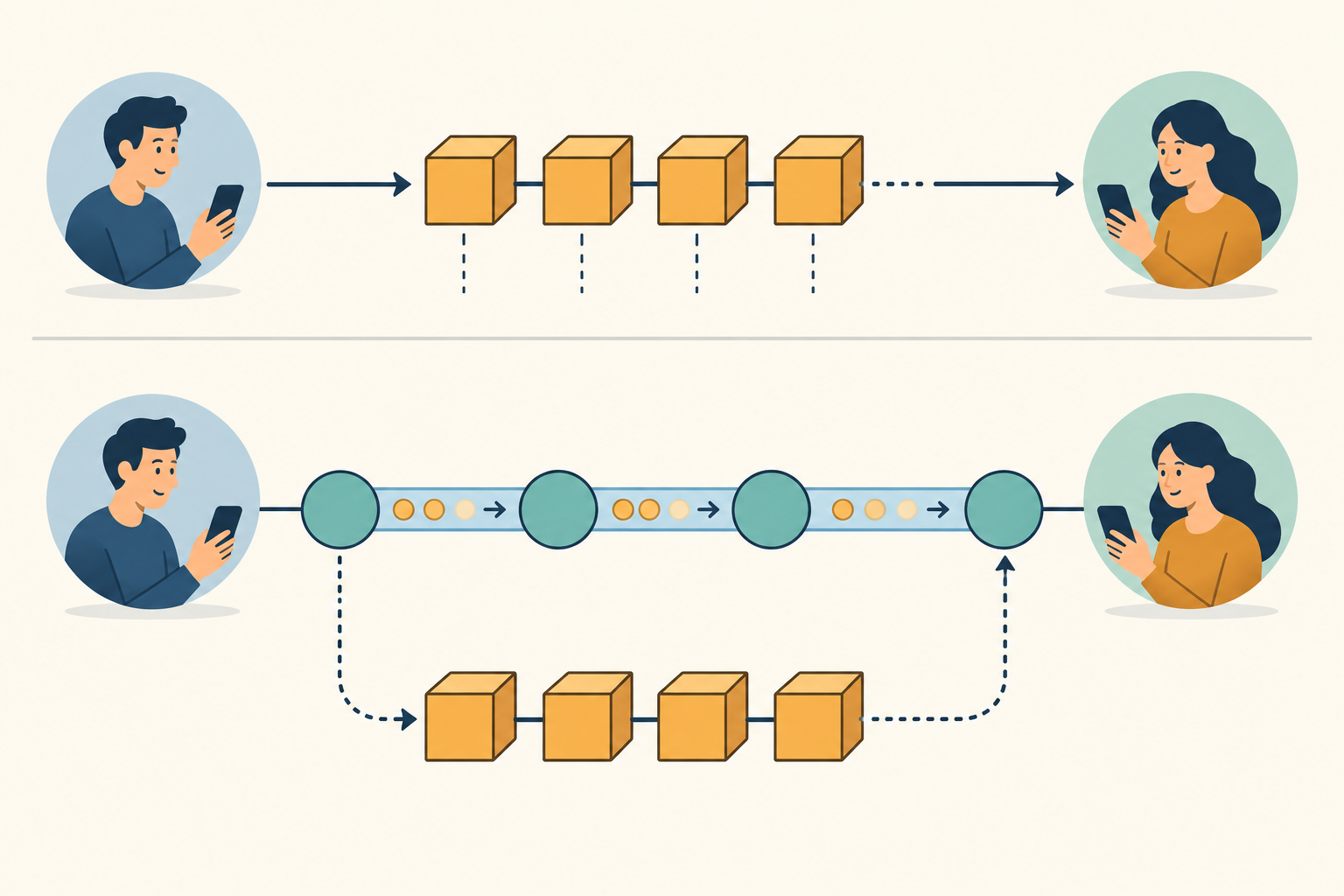
Both paths can transfer value denominated in bitcoin, but they do not use the base chain in the same way. An on-chain payment creates a Bitcoin transaction for the network to relay and miners to include in a block. A Lightning payment attempts to move value through a route of payment channels; the individual payment is not written as its own Bitcoin transaction.
That difference changes the fee, availability, privacy, and settlement signals a wallet can show. Lightning is not a different coin, and “off-chain” does not mean a payment has no rules or risk. The channel participants use Bitcoin transactions to establish and, if needed, resolve channel balances.
An on-chain payment is a transaction waiting for block inclusion
A wallet selects spendable outputs, constructs and signs a transaction, then broadcasts it to Bitcoin nodes. Nodes may relay it and hold it in their local mempools while it waits for a miner to include it in a block. The transaction fee is tied to transaction size and the offered fee rate, not simply to the amount of bitcoin being sent. See the Bitcoin Developer Guide to payment processing.
A transaction ID lets the sender and recipient inspect the broadcast transaction, but seeing it does not mean it has been confirmed. One confirmation means a block includes it; more blocks build on that block. The recipient’s service or personal risk policy determines how many confirmations it waits for. Block timing and confirmation requirements are not a promise that a payment will be available by a particular minute.
A Lightning invoice asks a wallet to find a payment route
A recipient can provide a Lightning invoice that encodes a payment request, often including an amount, destination, description, and expiry. The payer’s wallet parses it and looks for a route with enough eligible channel capacity and acceptable limits. The BOLT 11 invoice specification describes the request fields; BOLT 7 describes channel announcements and routing updates.
A routed payment uses conditional transfers commonly described through hash time-locked contracts. Each forwarding hop is given the amount and time conditions it needs; the final recipient reveals the payment secret needed to complete the route. A route can still fail if a channel cannot carry the required amount, an advertised update is stale, a limit is reached, or a peer is unavailable. Lightning can avoid waiting for a new block for each successful payment, but it does not promise every invoice will succeed.
Channel capacity is not the same as spendable balance
A payment channel starts with an on-chain funding transaction and has a total capacity. As participants pay each other, the current balance shifts between them without publishing a separate Bitcoin transaction for every update. What one side can send now depends on the balance in that direction, channel reserves, payment limits, and the route chosen. The BOLT 2 peer protocol describes channel parameters and HTLC limits.
A channel with enough total capacity may still lack enough outbound liquidity for a particular payment. A recipient may also lack a usable inbound path for the amount. Opening a channel, changing liquidity, or closing a channel can involve on-chain transactions and on-chain fees. BOLT 5 channel handling explains cooperative and unilateral close paths. The illustration below separates repeated channel payments from the funding and closing transactions that settle on Bitcoin.
The fee models answer different questions
An on-chain fee is paid for block space. Its total depends on transaction size and the fee rate chosen for current conditions; a larger transaction can cost more even when it sends less bitcoin. A wallet estimate is a moving estimate, not a reservation in a future block.
Lightning forwarding fees are set by channel operators and can combine a base amount with a proportional amount; route length, policies, liquidity, and wallet behavior affect the total. Some wallets may also include their own charge or liquidity-related costs. A Lightning payment may cost less for a particular use, but it is not always free or always cheaper than an on-chain payment. Compare the final amount, fee details, and route requirements shown by the wallet before approving.
Payment success is not the same signal as block confirmation
For an on-chain payment, a wallet may show broadcast, pending, or confirmed status. The blockchain provides public transaction and block data, and the recipient can apply a confirmation threshold suited to the amount and context. A transaction can remain unconfirmed longer than expected; a fee estimate does not control miner selection.
For Lightning, the recipient’s invoice is paid when the route completes and the wallet receives a success result. That payment is not individually included in a Bitcoin block. A failed attempt is not a confirmation, and an uncertain screen should not be treated as proof that a second payment is safe. Check the sending wallet’s final status and the recipient’s invoice or receipt before trying again.
Privacy, custody, and availability are separate choices
On-chain transaction data is public and can be analyzed, although an address is not automatically a person’s name. Lightning onion routing is designed to limit what a forwarding node learns about the full path, but it does not make every payment anonymous. The BOLT 4 onion-routing specification and public channel updates in BOLT 7 describe parts of that privacy model.
Wallets also differ in who controls the keys and how channels are monitored, backed up, and recovered. A self-custodial wallet and a hosted or custodial Lightning account do not have identical responsibilities or failure modes. Internet access, peer availability, channel state, recovery procedures, and the provider’s terms can matter. “Lightning” alone does not tell you whether a wallet is custodial, how it protects backups, or whether it offers the fallback you expect.
Choose the route the recipient can actually accept
On-chain can suit a recipient that gives you a Bitcoin address and needs a transaction that can be checked on the blockchain. Lightning can suit a supported wallet-to-wallet payment when both sides can use a compatible invoice and a route has enough usable liquidity. Frequent smaller payments may benefit from channel reuse, but opening, maintaining, and closing channels have their own constraints and costs.
Before sending, confirm the payment type, network, amount, invoice expiry, recipient, displayed fee, and any limits. Do not paste a Lightning invoice into an on-chain address field or send to an address using a route the recipient did not request. Some requests may provide an on-chain fallback, but use it only when the invoice, wallet, and recipient explicitly support it. For on-chain transfers, review the transaction-fee guide, deposit confirmation guide, and transfer checklist.
Common questions
Q1Does Lightning use bitcoin or a separate cryptocurrency?
Lightning payments are denominated in bitcoin, often displayed in satoshis. The payment route uses channels rather than recording each payment as its own base-layer transaction.
Q2Does Lightning remove on-chain fees?
No. Each Lightning payment does not normally require its own on-chain transaction, but channel opening and closing can use on-chain transactions. The wallet may also show routing or service charges.
Q3Are Lightning payments always instant and free?
No. A successful payment can complete without waiting for a new block, but a usable route, channel liquidity, limits, peer availability, and fees still matter. A wallet should show whether the payment succeeded or failed.
Q4Can I pay a Lightning invoice from any Bitcoin address?
Not directly. A Lightning invoice and an on-chain address request different payment paths. Use an on-chain fallback only when the request and wallet explicitly provide and support one.
Sources and further reading
Report an issue
We’ll prepare an email with this article link. Mark receives the report only after you send it
Quick check
Read the guide? Check yourself with 3 questions
Question 01
What is normally recorded on Bitcoin’s blockchain for each successful Lightning payment?
Choose an answer to see the explanation
Options glossary
A call or put whose strike is near the underlying price; it has little intrinsic value and often substantial sensitivity to time and volatility.
Read the deeper guideCall optionA contract that gives its holder the right, but not the obligation, to buy the underlying at the strike before or at expiration under the contract terms.
Read the deeper guide